
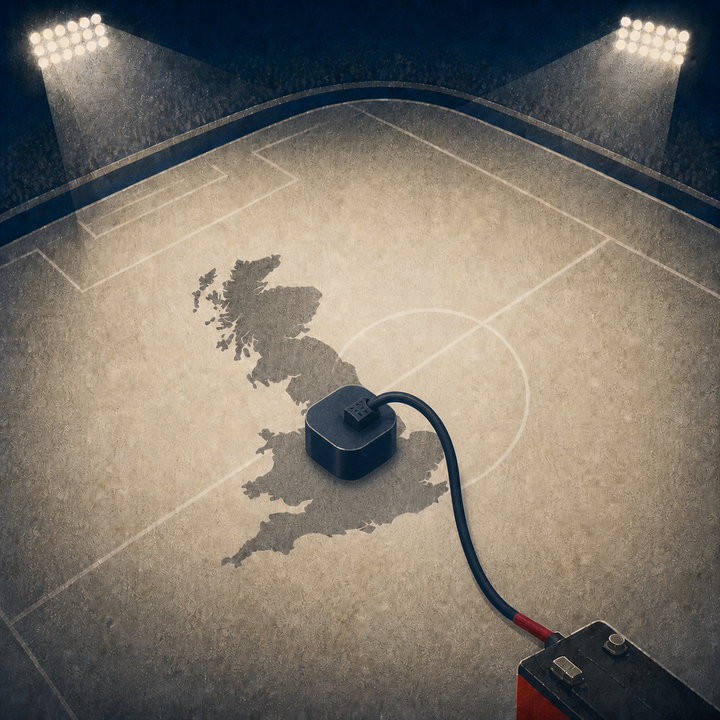
Britain may be on course to export electricity while France rebuilds and Germany improvises. But a winning energy strategy assembled on a Chinese-controlled battery supply chain comes with a rather awkward small print.
1. The problem — a promising table, not a trophy
Britain has spent much of this century playing European energy football with one boot missing: rich in wind, poor in storage and vulnerable to imported gas. The fixture may finally be turning.
NESO’s latest pathways see Great Britain becoming a net electricity exporter beyond 2030, as offshore wind increasingly produces more power than the domestic market needs at certain times. That is a pathway, not a promise. The difference is roughly the distance between topping the league in August and collecting the trophy in May.
The continental opposition has problems of its own. France’s public auditor says EDF faces an investment programme of up to €460bn between 2025 and 2040, including more than €200bn for nuclear renewal. Germany closed its final three nuclear stations in April 2023.
Britain therefore has an opening. It does not yet have a goal.
2. The reasons
Plan — a formation appears
The government’s Clean Power 2030 plan calls for 43–50GW of offshore wind, 27–29GW of onshore wind, 45–47GW of solar and 23–27GW of battery capacity by the end of the decade. It also identifies 80 network and enabling projects needed to make the system work.
This is recognisable as a formation: generation, storage and grid capacity advancing together. Previous British energy policy often resembled eleven players meeting in the tunnel.
Policy — some boots are already on
Great British Energy–Nuclear signed a contract with Rolls-Royce SMR in April, beginning design work for a three-unit project expected to provide at least 1.4GWe. It has not reached final investment decision, but it has moved beyond ministerial throat-clearing.
Off Yorkshire, Dogger Bank’s three phases will provide 3.6GW. NatPower says it has 12.5GW and 100GWh of battery storage and renewable generation in development. A pipeline is not a power station, but it is more useful than ambition alone.
Performance — the Shenzhen transfer clause
The revolution making this formation possible is storage. Lithium-ion cell prices have fallen by more than 99% since 1991, from roughly $9,200 per kilowatt-hour to $78. Cheap batteries allow intermittent wind and solar to behave more like dependable capacity.
The catch is where they come from. In 2025, China accounted for more than 80% of battery-cell production, around 85% of cathode material and over 90% of anode material. Britain can build a more flexible grid while becoming less flexible geopolitically. The new boots fit beautifully; the agent in Shenzhen still owns the contract.
3. Final whistle — ahead on optionality
Britain is not yet Europe’s power socket. But it has a plausible route to becoming one: a large renewable resource, new nuclear options, expanding storage and interconnectors capable of selling surpluses abroad.
The UK recorded an £18.4bn current-account deficit in the final quarter of 2025. Electricity exports will not erase it, but turning energy into an exportable service would improve resilience and bargaining power.
Scoreline: Britain leads on strategic optionality. France retains nuclear depth. Germany retains industrial weight. Nobody should start engraving the cup.
4. Smart Power
The past — watch the 2022 replay
Europe has seen this match before. The European Commission describes Russia’s actions in 2022 as the weaponisation of gas supplies. A cheap input became a strategic choke point precisely when it was most needed.
Replacing dependence on Russian molecules with dependence on Chinese cells would be an improvement in carbon accounting, not necessarily in statecraft.
The future — own more of the platform
Britain need not manufacture every cell. It does need multiple suppliers, stronger recycling and enough domestic processing to withstand disruption. The government’s Critical Minerals Strategy promises diversification and aggregated British demand. The test is delivery: storage policy should reward resilience as well as the cheapest bid.
The cost — pay now, or pay while losing
This transformation will be expensive. Britain’s earlier Beyond 2030 blueprint identified £58bn of grid investment to 2035. Yet delay has a price too. NESO now warns that without reinforcement, system-balancing costs could rise roughly threefold between 2031 and 2035.
Britain can rent the platform and hope its owner remains friendly. Or it can spend more to control the parts that matter. The second option is dearer. The first merely hides the invoice until added time.
The Power Brief gives you the match. The Situation Report gives you the season — the full table, the future trend, and the leaders who found a way back.
Inside the SitRep:
- Weekly wrap-ups that dig deeper then the Power Brief's
- the 2030 forecasts
- the leaders who used Smart Power to escape the same trap
- and more!
If you want to stop guessing and start seeing where Britain is actually heading, this is the guide that does it.