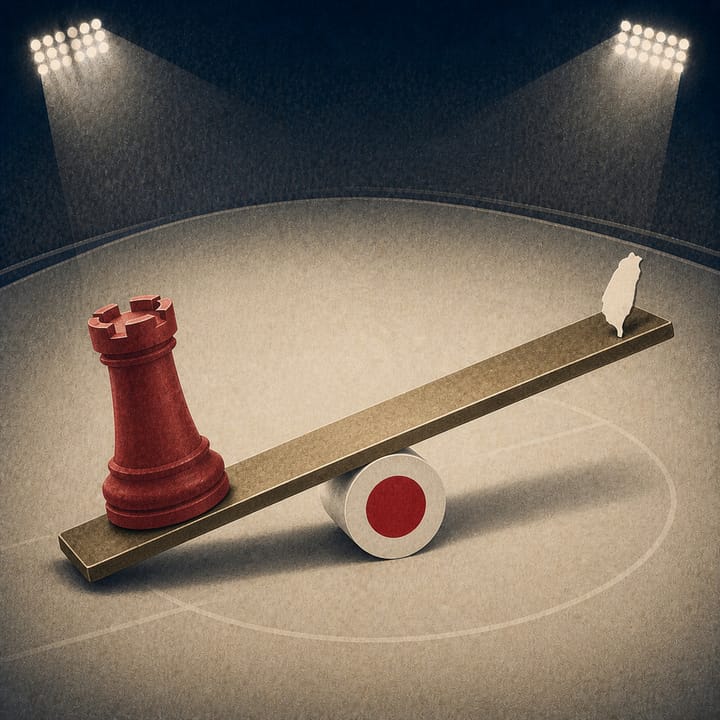
Japan’s 2026 defence white paper says the military balance across the Taiwan Strait is rapidly tilting towards China. The most dangerous shift is not one new weapon. It is Beijing’s ability to make coercion look normal before a crisis begins.
1. The problem — a warning, not a countdown
Tokyo has put the uncomfortable sentence in plain English. Japan’s official 2026 defence white-paper digest says the overall military balance across the Taiwan Strait is “rapidly tilting” in China’s favour. It also warns that Chinese military activity around Taiwan is intensifying and that a grey-zone blockade involving coastguard vessels is a possibility.
This is serious. It is not a prediction that war is imminent, nor a countdown to a fixed invasion year. Strategic warnings become less useful when they are converted into cinema trailers.
The real change is quieter. China does not need to cross the threshold of war to improve its position. It can rehearse encirclement, increase the routine presence of aircraft and ships, test Taiwan’s responses and make each episode slightly less exceptional than the last. The rehearsal becomes the routine; the routine changes the balance.
2. The reasons
Plan — win room for manoeuvre
Beijing’s advantage is not simply a larger inventory. It is the ability to create more options while forcing everyone else to guess which option is real.
Japan’s defence ministry says China’s operations around Taiwan increasingly have three features: they are more operational, more propagandised and more normalised. Exercises can improve combat readiness, signal political displeasure and create a new baseline at the same time. That is efficient statecraft, even when it is coercive.
The objective is not necessarily to launch a war tomorrow. It is to make Taiwan and its partners spend more time, money and political attention responding today—while leaving Beijing with the initiative.
Policy — deterrence is more than procurement
The standard response is to compare ships, aircraft and missiles. Those figures matter, but they are the team sheet rather than the result.
Deterrence depends on whether Taiwan can keep command systems working, disperse aircraft and munitions, repair ports and runways, preserve fuel and power, and communicate with the public after the opening shock. It also depends on whether partners can share information and reach decisions before a fast-moving crisis becomes a fait accompli.
The Smart Power answer is therefore broader than buying more weapons. Military power must be joined to State Power: resilient institutions, civil preparedness, secure communications and credible decision-making. Diplomatic Power must make clear that restraint will be rewarded and coercion will carry coordinated costs.
Performance — watch the baseline
The annual figures are stark. According to CSIS’s ChinaPower analysis of Taiwan Ministry of National Defense data, PLA aircraft made 3,764 incursions into Taiwan’s de facto air-defence identification zone in 2025, 22.4% more than in 2024.
An ADIZ is not sovereign airspace, and an incursion is not an attack. Precision matters. So does the pattern.
CSIS also found that incursions between May and December 2025 were 5.4% lower than in the same months of 2024. That qualification does not make the problem disappear. It suggests that the higher operational tempo established after May 2024 had become a durable baseline rather than an endlessly accelerating line.
That is the more revealing scoreboard. The danger is not that every month must set a record. It is that an exceptional level of pressure can settle into normality.
3. Final whistle — the balance is political too
Japan is not declaring that Taiwan is doomed. It is warning that the conditions under which political choices will be made are deteriorating.
If Beijing can operate more often, closer and with less surprise, it gains leverage before any shot is fired. If Taipei and its partners can absorb pressure without panic, keep essential systems functioning and deny a quick success, the apparent military imbalance becomes less politically decisive.
Scoreline: China leads on mass and operational tempo. Taiwan still has geography, preparation and international partnership. Japan has sounded the alarm. The next move is to turn that warning into performance.
4. Smart Power
The past — Berlin without the airlift
The closest lesson is not Pearl Harbor. It is Berlin in 1948. The Soviet blockade tested whether the Western allies could sustain a vulnerable position without starting a wider war. The American and British airlift answered coercion with logistics, alliance discipline and political endurance.
The lesson is not that Taiwan is West Berlin. It is that deterrence can turn on the unglamorous capacity to keep a society supplied and a coalition aligned when an opponent applies pressure below the threshold of open war.
The future — make coercion fail slowly
The aim should not be to promise that every Chinese move will be stopped. It should be to make coercion unreliable.
That means redundant communications, distributed stockpiles, rapid repair, harder ports and airfields, civil-defence practice and clear alliance procedures. It also means leaving Beijing a diplomatic route back from escalation. A strategy with only punishments is a trap with no exit.
Britain — not a spectator, not the sheriff
Britain is not Taiwan’s treaty guarantor and should not pretend otherwise. But it has interests and instruments. The UK has formally opposed unilateral changes to the status quo and expressed concern about destabilising Chinese military exercises around Taiwan.
It is also building the next generation of combat aircraft with Japan and Italy. In July, Canada joined the Global Combat Air Programme as its first observer nation, widening a project that already links British industry directly to Japanese security planning.
The useful British contribution is therefore neither chest-beating nor absence. It is industrial cooperation, intelligence, sanctions coordination, resilient supply chains and diplomacy that connects Euro-Atlantic and Indo-Pacific partners.
China’s pressure works by making each rehearsal look manageable in isolation. Smart Power begins by seeing the cumulative performance—and ensuring the routine never becomes irreversible.
The Power Brief gives you the match. The Situation Report gives you the season — the full table, the future trend, and the leaders who found a way back.
Inside the SitRep:
- Weekly wrap-ups that dig deeper then the Power Brief's
- the 2030 forecasts
- the leaders who used Smart Power to escape the same trap
- and more!
If you want to stop guessing and start seeing where Britain is actually heading, this is the guide that does it.