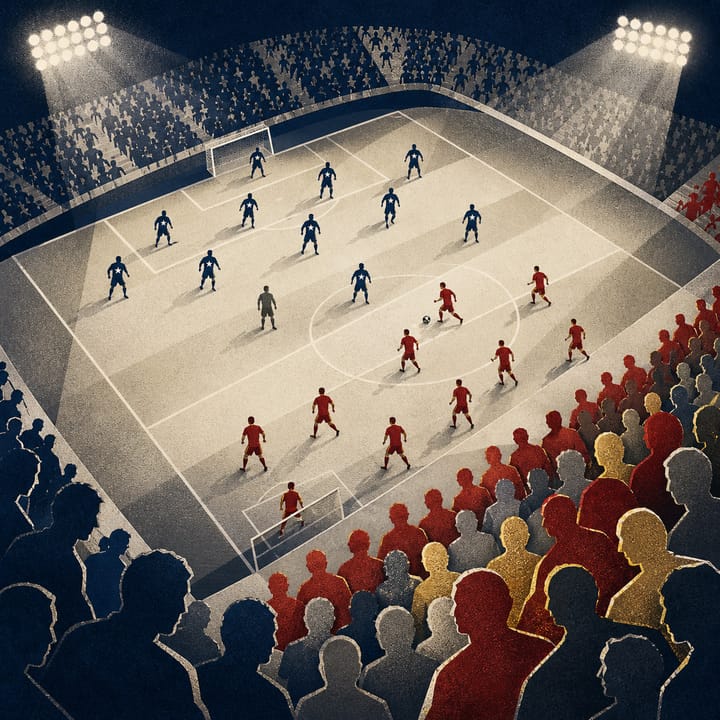
America still leads the soft-power league. But its score is falling, allied approval is sliding and China is closing the gap. The richest squad in geopolitics is discovering that possession is not authority.
The flattering league table
League tables are catnip to great powers. They turn a messy contest of trust, culture and legitimacy into something reassuringly numerical. For America, the latest table still offers the comfort of first place. It also supplies the sort of small print that gets managers sacked.
Brand Finance’s 2026 Global Soft Power Index gives the United States a score of 74.9. That is enough to remain top, but it is 4.6 points lower than a year earlier—the steepest fall among the 193 countries measured. China is second on 73.5, less than a point and a half behind.
This is not an American collapse. The country still has the world’s most recognisable shirt: Hollywood, Silicon Valley, elite universities, deep capital markets and a military alliance network no rival can match. Yet the lead is now narrow enough to expose a strategic problem. America’s assets remain formidable; their conversion into consent is becoming less efficient.
Possession is not authority
The approval numbers tell the same story from another stand. Gallup’s surveys in more than 130 countries found median approval of US leadership falling from 39% in 2024 to 31% in 2025. China moved in the opposite direction, from 32% to 36%.
That does not mean the world has fallen in love with Beijing. Gallup’s own figures suggest that China’s lead owes much to America’s decline rather than to a rush of new admirers. The contest is not between a universally loved side and a villain. It is between one power becoming more acceptable and another becoming harder to explain.
This is where soft-power rankings can flatter. Familiarity is not affection, and attention is not authority. A country can dominate transfer gossip, sell the most shirts and still lose midfield. Power becomes smart only when hard assets—money, technology, force and access—are combined with enough legitimacy that others choose to cooperate.
The away end grows quieter
The most uncomfortable figures come from America’s own supporters. Across 31 NATO countries, Gallup recorded a 14-point fall in median approval of US leadership, to 21%. Allies may still depend on American security guarantees while becoming less willing to applaud the conduct of the guarantor. The turnstiles remain busy; the chants are less enthusiastic.
Nor is the shift confined to the alliance. Pew Research Center’s 2026 survey found China viewed more favourably than the United States in most of the 36 countries surveyed. America retained the more favourable image in only six. That finding should not be mistaken for a global transfer of allegiance. Public opinion is rarely zero-sum, and views of both countries remain mixed. But it does show that American primacy can no longer be treated as the default setting.
China’s disciplined away form
China does not need to play beautiful football. It needs to look organised while its opponent appears erratic. A reputation for economic scale, infrastructure and long-term planning can gain ground even when Beijing’s political model attracts little affection. Predictability has a soft-power value of its own.
Washington therefore faces a subtler rival than propaganda alone can defeat. The problem is not simply that China is telling a better story. It is that American behaviour increasingly supplies the plot. Sudden policy reversals, transactional treatment of allies and a widening gap between national rhetoric and national conduct all make US leadership more expensive for partners to defend.
Final whistle
America is not finished. It still has the richest squad in geopolitics and more ways to recover form than any competitor. But old trophies do not count as current points.
The repair begins with three unfashionable virtues: consistency, consultation and delivery. Treat allies as players rather than spectators. Measure influence by the cooperation it produces, not the attention it attracts. And ensure that America’s account of itself bears some resemblance to what partners experience.
The United States remains top of the soft-power table. The question is whether it still has the dressing room. Smart Power is the work of making sure that it does.
The Power Brief gives you the match. The Situation Report gives you the season — the full table, the future trend, and the leaders who found a way back.
Inside the SitRep:
- Weekly wrap-ups that dig deeper then the Power Brief's
- the 2030 forecasts
- the leaders who used Smart Power to escape the same trap
- and more!
If you want to stop guessing and start seeing where Britain is actually heading, this is the guide that does it.