
Transparency International Corruption Perceptions Index 2025
Comprehensive Assessment: United Kingdom and United States
Executive Summary
The 2025 Corruption Perceptions Index reveals record-low scores for both the United Kingdom and United States. The UK dropped to 70/100 (20th place), its lowest score since 2012, while the USA fell to 64/100 (29th place), also a historic low. Both countries have fallen from the global anti-corruption leadership tier, now trailing countries like Lithuania, Barbados, and Uruguay.
Transparency International explicitly warns that this decline is "not a temporary blip" and risks becoming "a defining feature of political culture" in both nations.
Section 1: United Kingdom — Full TI Assessment
Current Position (CPI 2025)
- Score: 70/100 (down from 71 in 2024)
- Ranking: 20th out of 182 countries
- Status: Lowest score since the 2012 methodology revamp; stuck at 20th for the third consecutive year
Source: Transparency International UK
Historical Trajectory (2012–2025)
| YEAR | RANKING | SCORE | NOTES |
|---|---|---|---|
| 2012 | 17th | — | Methodology change year |
| 2015 | 7th | — | High point |
| 2017 | 8th | — | Still in top 10 |
| 2022 | 18th | — | — |
| 2024 | 20th | 71 | — |
| 2025 | 20th | 70 | Record low |
Net change 2015–2025: −13 positions in ranking (7th → 20th), −1 point in score
Source: The Guardian
Specific Named Causes Identified by Transparency International
1. Donor Funding and Political Donations
Transparency International explicitly cited:
- Record spending on election campaigning that "supercharged a reliance on wealthy backers"
- Conservatives accepted £15 million from a single donor (Frank Hester) in less than 12 months
- Elon Musk reportedly considered a $100 million (£85 million) donation to Reform UK
Source: Transparency International UK
2. Cash for Access and Cronyism
- Labour's largest donor (Waheed Alli) received a privileged pass to Number 10 Downing Street
- Labour Party, lobbyists and parliamentarians soliciting cash in return for privileged political access
- Several appointments to donors without following due process
3. Political Appointments
- Criticism of political appointments for party donors
- Questionable public appointments processes
4. Epstein/Mandelson Scandal
- Revelations about the relationship between former Ambassador Peter Mandelson and convicted sex offender Jeffrey Epstein
- Police investigation into Mandelson for allegedly passing market-sensitive information to Epstein
- TI UK warned this scandal "does huge damage to public trust"
Source: The Guardian
Key Quotes from Daniel Bruce (Chief Executive, Transparency International UK)
"For three years running, the UK has been stuck at 20th place in the Corruption Perceptions Index with a score that continues to deteriorate. This persistent decline is not a temporary blip — it risks becoming a defining feature of our political culture."
"The data collection period for this year's index covers some of the highest spending political campaigning on record, alongside troubling reports of access-for-cash arrangements and questionable appointments processes. Unless we act decisively to tackle the corrupting influence of big money in politics and strengthen anti-corruption frameworks, these concerns will become the new normal."
"The UK government must demonstrate that it is serious about restoring integrity. That means taking bold action to remove big money from politics, delivering genuinely open government, and ending the cronyism that undermines public trust in our institutions."
"We are not tackling the root causes of corruption in our politics."
Sources: TI UK, The Guardian, CNN
UK Government Response
"This government is committed to tackling corruption and protecting working peoples hard-earned money. Our anti-corruption strategy targets corrupt actors directly, cutting off their influence and strengthening the systems that protect our democracy. This strategy brings more corrupt individuals in the UK to justice and includes £15m of new funding for an expanded domestic corruption unit."
Source: The Guardian
TI UK's Forward Assessment and Recommendations
Warning: Corruption concerns are "risking becoming embedded as the 'new normal'"
Assessment: Business as usual is "not enough to turn the corner"
Three key recommendations:
- Protect democracy by removing big money: Place a meaningful cap on donations; reduce campaign spending limits; increase transparency over the source of funds; strengthen the Electoral Commission
- Deliver open government: Extend transparency requirements to all lobbyists, requiring more detail about interactions (as in Canada, Germany, and the US)
- End cronyism in Parliament: End MPs holding second jobs; reform the process for making appointments to the Lords; remove those found engaged in serious misconduct
Source: Transparency International UK
Section 2: United States — Full TI Assessment
Current Position (CPI 2025)
- Score: 64/100 (lowest ever recorded)
- Ranking: 29th out of 182 countries (down from 28th in 2024)
- Status: Lowest rank and score since the 2012 methodology revamp
Source: CNN
Historical Trajectory (2012–2025)
| YEAR | RANKING | SCORE | NOTES |
|---|---|---|---|
| 2012 | 19th | — | Following methodology change |
| 2015 | — | — | Peak period (implied higher) |
| 2024 | 28th | — | — |
| 2025 | 29th | 64 | Record low |
Net change decade: −12 points in score over the previous decade
Source: Transparency International US
Specific Named Causes Identified by Transparency International
1. Trump Administration Actions
- Use of public office to target and restrict independent voices such as NGOs and journalists
- Normalisation of conflicted and transactional politics
- Politicisation of prosecutorial decision-making
- Actions that undermine judicial independence
Source: The Guardian
2. Foreign Corrupt Practices Act (FCPA) Freeze
- Temporary freeze and weakening of enforcement of the FCPA
- Reduction in enforcement resources for the landmark foreign anti-bribery law
- Signals "tolerance for corrupt business practices"
Source: CNN
3. DOJ Politicisation
- Dangerous misuse of government authorities originally established for politically neutral enforcement
- Selective and politically motivated enforcement
- Use of enforcement discretion to politically determine winners and losers
- Selective loosening of market rules to favor politically connected actors
Source: Transparency International US
4. Judicial Independence Concerns
- Actions undermining judicial independence
- Undermining of checks and balances
5. NGO Restrictions
- Cuts to US aid for overseas civil society
- Weakened global anti-corruption efforts
- Targeting of independent voices including advocates and journalists
6. Democratic Backsliding Pattern
- Part of broader pattern of established democracies experiencing decline
Key Quotes from TI Leadership
Maíra Martini (CEO, Transparency International):
"We are very concerned about the situation in the United States. This declining trend might continue."
"At a time of climate crisis, instability and polarisation, the world needs accountable leaders and independent institutions to protect the public interest more than ever — yet, too often, they are falling short."
Sources: CNN, Transparency International
Gary Kalman (Executive Director, Transparency International US):
"The use of enforcement discretion to politically determine winners and losers, and the selective loosening of market rules to favor politically connected actors, undermine core principles of the rule of law, fair competition, and anti-corruption. Anti-corruption laws should be there to serve the public interest, not be distorted to advance narrow political or economic interests."
"Perhaps most alarming is that these actions encourage leaders in other countries to further target and restrict independent voices, including advocates and journalists."
"Beyond the CPI findings, the temporary freeze and weakening of enforcement of the Foreign Corrupt Practices Act signal tolerance for corrupt business practices, while cuts to US aid for overseas civil society have weakened global anti-corruption efforts."
Source: Transparency International US
Peer Comparisons — Countries Now Ahead of the USA
The USA (29th, score 64) is now:
- Tied with: The Bahamas
- Beaten by:
- Lithuania (28th)
- Barbados (24th)
- Uruguay (17th)
- Also behind: UAE, Bhutan, Seychelles
Source: CNN
TI's Forward Assessment
Warning: "Although 2025 developments are not yet fully reflected, actions targeting independent voices and undermining judicial independence raise serious concerns."
Assessment: Declining trend "might continue"
Important note: CPI data collection (January–September 2025) did not fully capture all events from Trump's second presidency
Source: The Guardian
Section 3: Global Context and Leadership Warning
Key Global Statistics
Lowest in more than a decade
More than two-thirds of all ranked
Down from 12 a decade ago
Sources: Transparency International, CNN
The Shrinking "Clean" Club
| COUNTRY | SCORE | 2025 RANK |
|---|---|---|
| Denmark | 89 | 1st (8th consecutive year) |
| Finland | 88 | 2nd |
| Singapore | 84 | 3rd |
| New Zealand | 81 | 4th |
| Norway | 81 | 4th |
| Sweden | 80 | 6th |
| Switzerland | 80 | 6th |
Source: Transparency International
Democratic Backsliding Pattern
- Even established democracies (US, UK, Canada, New Zealand) are experiencing decline
- 50 countries have seen significant score declines since 2012
- Biggest decliners: Türkiye (−31), Hungary (−40), Nicaragua (−14)
Source: Transparency International UK
TI's Warning on Leadership Gap
Sources: Transparency International, The Guardian
What This Means for Global Anti-Corruption Leadership
The number of countries scoring above 80 has shrunk from 12 a decade ago to just 5 in 2025. This represents a 58% reduction in the number of countries considered to have strong anti-corruption frameworks.
The UK and US, traditionally seen as global leaders in governance standards, have now fallen to the middle tier of the index, undermining their ability to advocate for anti-corruption reforms internationally.
Section 4: UK vs USA Direct Comparison
| METRIC | UNITED KINGDOM | UNITED STATES |
|---|---|---|
| 2025 Score | 70 | 64 |
| 2025 Rank | 20th | 29th |
| Change from 2015 | −13 positions (7th → 20th) | — |
| Record Status | Lowest since 2012 | Lowest since 2012 |
| Primary Driver | Donor funding, cash for access, cronyism | Trump admin actions, DOJ politicisation, FCPA freeze |
| Key Scandal | Mandelson-Epstein | — |
| Peer Position | Behind Estonia, UAE, Bhutan | Tied with Bahamas; behind Lithuania, Barbados, Uruguay |
| TI Warning | "New normal" risk | "Might continue" |
Section 5: Major Press Coverage Summary
| OUTLET | HEADLINE | KEY FOCUS |
|---|---|---|
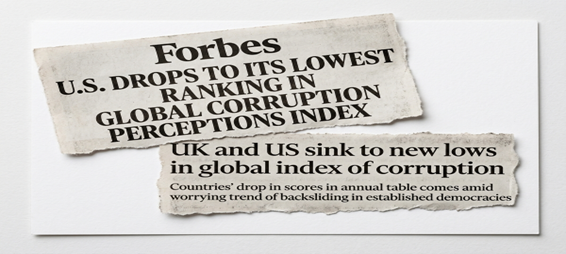
| The Guardian | "UK and US sink to new lows in global index of corruption" | Both countries; donor funding; Epstein/Mandelson |
| CNN | "The US slips to its lowest-ever rank in a global corruption index" | US decline; Lithuania/Barbados/Uruguay ahead; FCPA freeze |
| Forbes | "U.S. Drops To Its Lowest Ranking In Global Corruption Perceptions Index" | Tourism impact ($12.5bn loss); global average drop to 42 |
| TI UK | "Corruption concerns risk becoming 'new normal'" | Full UK analysis; Daniel Bruce quotes; recommendations |
| TI US | "U.S. Score Continues to Decline Amid Clear Signs of Democratic Backsliding" | Gary Kalman statement; FCPA; NGO restrictions |
| TI Global | "Decline in leadership undermining global fight against corruption" | Global press release; François Valérian quote |
Section 6: Forward Warnings and Projections
United Kingdom
Risk: Corruption concerns becoming "embedded as the new normal"
Window for action: Business as usual "not enough to turn the corner"
Immediate pressure: Mandelson-Epstein scandal likely to fuel further deterioration in 2026
United States
Risk: Declining trend "might continue"
Data gap: 2025 developments not fully reflected; Trump's second presidency actions may further depress score in 2026
Global contagion: US actions encourage other countries to target independent voices
Global
Trend: Global average at 42, lowest in more than a decade
Clean governance club: Shrunk from 12 countries to 5 in a decade
Warning: "The world needs principled leaders and strong, independent institutions that act with integrity to protect the public interest. Yet, too often, we are seeing a failure of good governance and accountable leadership."
Conclusion
The 2025 Corruption Perceptions Index represents a watershed moment for both the United Kingdom and United States. After decades of global anti-corruption leadership, both nations have fallen to historic lows, undermining their moral authority and strategic position.
Transparency International's assessment is unambiguous: this is not a temporary decline, and without decisive action, corruption concerns risk becoming "a defining feature of political culture" in both countries.
The specific causes identified — donor capture, politicised enforcement, judicial independence concerns, and attacks on civil society — represent structural failures that will require comprehensive reform, not incremental adjustment.
With the global average at its lowest level in over a decade and the club of "clean" countries shrinking by 58%, the world is experiencing a profound crisis of anti-corruption leadership. The question now is whether the UK and US can reverse course before the damage becomes irreversible.
Sources and References
- Transparency International — Corruption Perceptions Index 2025
- Transparency International UK — CPI 2025 Statement
- Transparency International US — CPI 2025 Statement
- The Guardian — "UK and US sink to new lows in global index of corruption"
- CNN — "The US slips to its lowest-ever rank in a global corruption index"
- Forbes — "U.S. Drops To Its Lowest Ranking In Global Corruption Perceptions Index"
- Transparency International Global Press Release
Document prepared: March 19, 2026
Research methodology: Deep analysis of official TI reports, press coverage, and leadership statements
Ghost CMS ready: All sections and tables can be copied directly into Ghost HTML cards