
Japan is watching China’s carriers. Beijing is building the trade dependence that may matter more.
What’s the problem?
On August 4th Japan’s cabinet approved Defense of Japan 2026. It describes China as an “unprecedented and the greatest strategic challenge” and records Chinese naval activity extending beyond the First Island Chain. The warning is sober, official and justified. Japan’s defence ministry sets out the evidence in its 2026 digest.
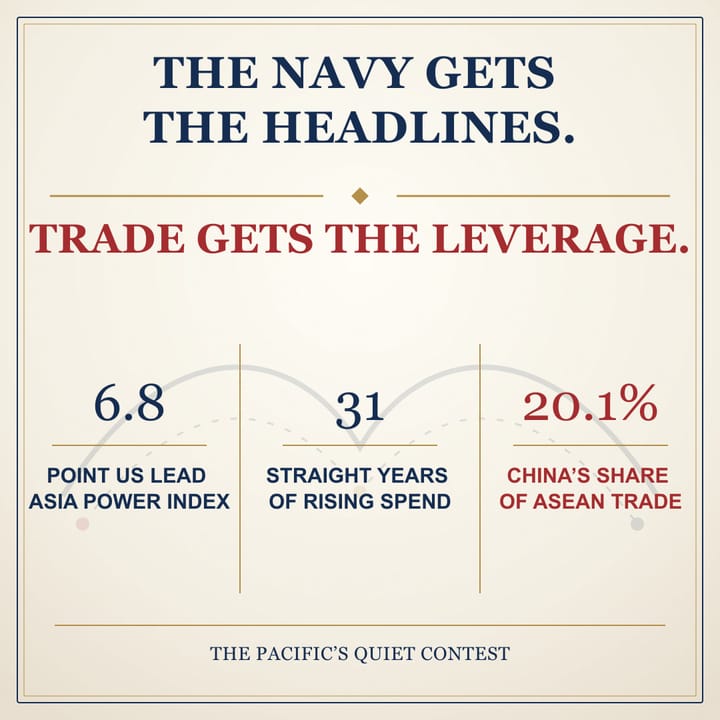
It is also only half the story. While Tokyo watches the fleet, Beijing is deepening the commercial ties that shape how Southeast Asian governments calculate risk. Chinese exports to ASEAN rose 38.36% year-on-year in July. China already accounts for 20.1% of ASEAN’s total trade. Warships can frighten a government; factories, orders and supply chains can narrow its room for manoeuvre.
Is history repeating itself?
Kaiser Wilhelm’s Germany challenged Victorian Britain by accumulation: a naval law, another ship, another diplomatic probe. Each move looked manageable. Together they produced a fleet race and hardened rival blocs.
China’s island-building in the South China Sea offered a more recent lesson. Construction proceeded feature by feature, below the threshold that would provoke war. The Philippines won its arbitration case in 2016, but the concrete remained. Gradual pressure works because defenders debate every increment while the strategic landscape changes underneath them.
The analogy is a warning, not a prediction. The Pacific is not pre-war Europe. Yet the danger is familiar: mistaking the absence of a single decisive act for the absence of a strategy.
Whose plan is better?
China’s, for now. Beijing is pursuing military reach and economic integration as complementary instruments. Its carriers test access to the western Pacific; its trade gives regional governments reasons to hedge. The two tracks reinforce one another.
Japan has a serious defence plan, but it depends upon American attention and an American alliance. Tokyo’s call for “comprehensive national power” acknowledges the gap. A strategy that borrows another capital’s bandwidth is exposed whenever that capital is distracted elsewhere.
Whose policy is better?
China is using more of the available board. Its military modernisation is backed by a commercial ecosystem whose scale is difficult to match. Trading Economics, drawing on Chinese customs data, records the July surge in exports to ASEAN. ASEAN’s own figures put two-way China trade at $772.4bn in 2024—one dollar in every five of the bloc’s commerce.
Japan and America retain formidable military and diplomatic assets. Their weakness is not a lack of power, but a thin economic counter-offer. Deterrence is less persuasive when the states it is meant to reassure cannot afford to offend the country being deterred.
Whose performance is better?
America remains first in the Lowy Institute’s Asia Power Index, scoring 80.5 against China’s 73.7. The visible gap is 6.8 points. But China’s material base continues to expand: military expenditure reached $336bn in 2025, up 7.4%, its 31st consecutive annual rise.
The more important performance test lies outside the index. China is converting production, finance and trade into strategic patience. Commercial dependence does not automatically purchase political obedience. It does, however, raise the cost of resistance. That is leverage.
Learning from the past, what is the solution?
Washington, Tokyo and their Quad partners should contest both tracks. ASEAN needs a practical offer: supply-chain investment, critical-minerals processing, clean-energy infrastructure and payment systems that do not depend on a single patron. Japan should accompany its defence white paper with an economic-security programme aimed specifically at Southeast Asia.
ASEAN governments also have agency. Diversified procurement, investment screening and limits on single-market exposure would preserve their ability to hedge. The aim is not to make them choose the West. It is to keep choice possible.
How much will it cost?
A serious allied economic-security programme would probably require tens of billions of dollars a year. As a League planning scenario—not an official forecast—$50–150bn over three years across America, Japan and other partners is a defensible order of magnitude. The money would matter less than speed, credible delivery and projects ASEAN governments actually want.
What is the cost of doing nothing?
Dependency compounds quietly. If present trends persist, contracts, logistics and industrial standards will increasingly be written around Chinese demand. ASEAN states may remain formally non-aligned while finding that neutrality has acquired a Chinese price.
Japan is right to watch the carriers. But the contest may be decided in ports, factories and balance sheets long before it is settled at sea. The navy gets the headlines. Trade gets the leverage.
The Power Brief gives you the match. The Situation Report gives you the season — the full table, the future trend, and the leaders who found a way back.
Inside the SitRep:
- Weekly wrap-ups that dig deeper then the Power Brief's
- the 2030 forecasts
- the leaders who used Smart Power to escape the same trap
- and more!
If you want to stop guessing and start seeing where Britain is actually heading, this is the guide that does it.