

In football, the league table never lies. Manchester City's dominance wasn't luck—it's £1 billion in transfers, Pep Guardiola's tactical genius, and relentless squad depth.
Similarly, in global power, the League of Nations Top Table reveals which countries have the firepower (military spending), the playmakers (diplomatic networks), and the financial muscle (economic output) to compete at the elite level.
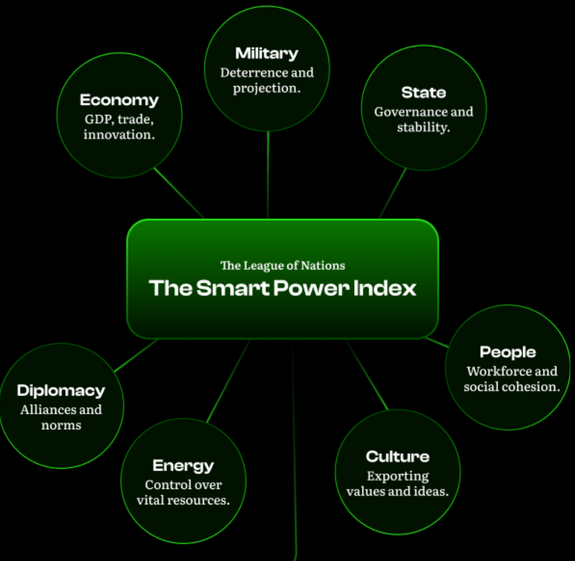
Since 1991, we've tracked 168 states across 30 games in seven leagues of power —Economy, Military, State, People, Energy, Culture, and Diplomacy— seeing how smart as well as strong they are - measuring their Smart Power scores with the precision of expected goals (xG) and possession statistics.
Today, let's look at the top of the table. Here’s the top 11 major powers. Strong and supposedly the smartest in the world.
The Premiership League.
Let's see how smart they've been.
Click replay to start the race, click on a year to stop or rewind it
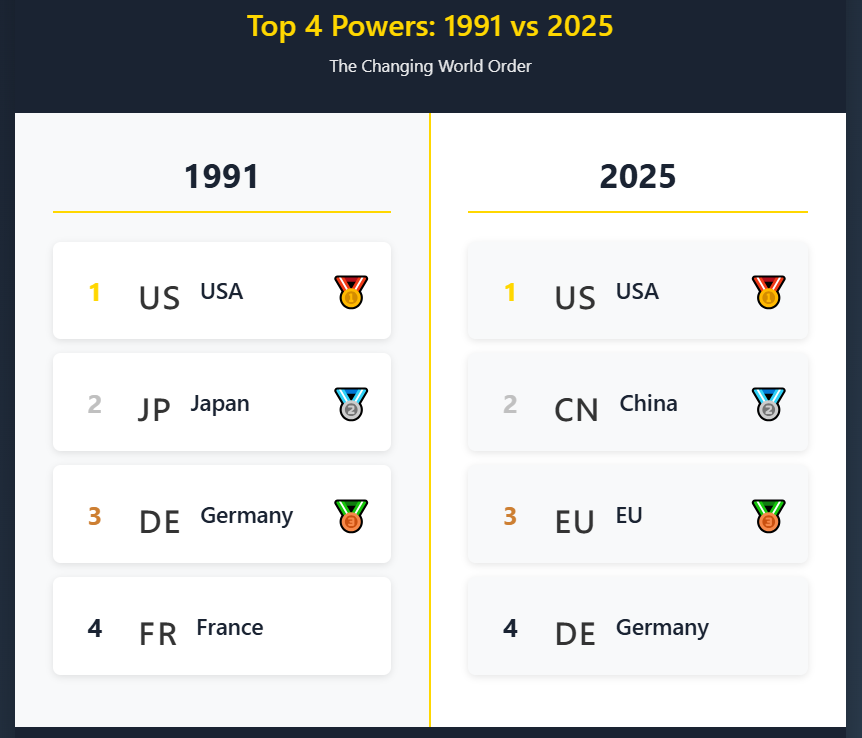
See how the top four have changed. Only the US and Germany are still in the top flight.
Look at the race again. Can you see the 6 amazing events have shaped the world we live in since the collapse of the USSR? Over 34 years once mighty teams have tumbled and minnows now threaten the old order. The story of our time has been the amazing rise of China and India and the slow slide of Japan and France. Britain, despite Brexit, has muddled through.
We're going to find out why.
Who's winning? Who's losing? When were the great crossover years?
These were the big moments when teams on the rise overtook teams in decline.
The big dramas that nobody knew about. When the world changed in front of our eyes:
- The rise of China: from 10th to 2nd in 20 years. You see big crossovers in 2005 and 2014
- The rise of Europe: from 5th to 2nd in 15 years, with crossovers in 1995 and 2009 before sliding to 3rd after Brexit
- The rise of India: from 11th to 8th in 10 years, crossing over in 2015 and 2023
But their rise, meant others suffered. This era saw:
- The fall of Japan: from 2nd to 5th in 15 years slipping in 2009
- The fall of France: from 4th to 7th in 30 years sliding in 1995, 2005 and 2013
- The fall of Russia: from 7th to 11th in 30 years after 2022
Each inflection point has a backstory—economic collapses, military overreach, diplomatic chaos, demographic time bombs. The 30 game metrics don't lie.
Leaders applying the 7 rules of smart power have won their 30 games, topped their 7 leagues and bucked their 7 cycles.
Before you go on, you should know the whole smart power theory here. Or just come back later.
Ok. Let's see how they've done it.
Have they been smart or stupid?
The 2025 standings confirm what the data has been telegraphing for a decade:
China is closing the gap on the USA like Liverpool chasing down Manchester United in the 1990s


- In 1991, America led China by 2,801 points—a margin so vast it seemed insurmountable, akin to a 50-point Premier League lead.
- By 2025, that gap has shrunk to 1,036 points.
- China's average annual gain? +98 points per season (1991-2025).
So who were the big winners and losers since 1991 - the dawn of the globalisation age?

THE WINNERS: Smart Power Champions
🥇 China — The Dragon Ascendant
The defining winner of the post-Cold War era. China executed the most ruthless, focused grand strategy in modern history. While others debated, China built. While others globalised, China weaponized globalisation. From 10th place to 2nd in a generation.
Their strategy resembles Guardiola's Barcelona: systematic investment in fundamentals (infrastructure, education, manufacturing capacity), tactical innovation (Belt and Road Initiative, technological leapfrogging), and relentless execution of long-term vision.
At this velocity, the crossover arrives between 2042-2045—the geopolitical equivalent of Leicester City's 5,000-1 title win.
USA - The declining hegemon
If that happens the USA is now 64% into its global hegemony. It began in 1991. The liberal globalisation order it imposed after the Paris Treaty (1990) is fracturing. Its basic model—entrepreneurial nation-state liberalism—faces mercantilist (China) and managerial (EU) challengers. Its public mandate (opportunity through globalisation) rings hollow as domestic inequality soars. The USA leads in military (20% weighting) and economy (40%), but, in the era of Trump, it's slipping down the state, people, culture and diplomacy leagues. China exploits every fissure: Belt & Road (diplomatic isolation), tech leapfrogging (5G, AI, quantum), energy pivot (solar dominance, rare earths monopoly).
Like Manchester United post-Ferguson, they've maintained competitiveness through economic strength and resource advantages, but lost the systematic superiority that once guaranteed dominance.
The critical inflection occurred in the 2010's, when China's economic model proved more resilient to global disruption while America's political dysfunction began constraining strategic execution.
The USA is at Stage 5 (Pressures) in the Thucydides Cycle—rival challengers in every league, hybrid wars across all seven powers. Without strategic reset, Stage 6 (Overreach) beckons by 2030, Stage 7 (Decline) by 2040.
It's coming.
- Like Germany overtaking Britain in 1935.
- The US overtaking Britain in 1918.
- The British overtaking France in 1763.
- The French overtaking the Habsburgs in 1618
- The Habsburgs overtaking the Papacy in 1519
Crossovers mean danger to the hegemon. Usually war.
INDIA — The Silent Riser
Then there's India (8th, 3,703 points), the Aston Villa of Smart Power—data-driven, upwardly mobile, and thriving on demographic moneyball.
India rose through demographic scale, tech leverage, and strategic non-alignment. It plays the great game without declaring absolute allegiance, extracting maximum value from both Western and Eastern orders.
Like Manchester City pre-Guardiola, they possess all ingredients for greatness but require exceptional leadership to realize potential. Their demographic dividend and technological capabilities position them as the decade's dark horse.
Their People Power (2nd globally, 425.21 points) is the Erling Haaland of assets: young (median age 28), prolific (1.45 billion population), and unstoppable. India's projected 2028 overtake of France isn't a Cinderella story; it's inevitable arithmetic. When your workforce grows 2% annually while your rival's stagnates, you don't need tactical genius—just time.
EU — The Fragile Giant
The EU grew in smart power significantly, but only as a collective. Internally fracturing, externally strong. One crisis from trouble, but for now—a smart power winner. It is the perpetual third—neither hegemon nor challenger, managerial bureaucrat of the global system. The EU model (managerial civilisation-state) prioritises regulation over innovation, welfare over opportunity. The elite (Brussels technocrats, Franco-German business cartel) lacks vision. Post-Brexit (2020), the EU lost 15% of its diplomatic weight, 12% of its GDP. It's at Stage 5 (Pressures)—holding position through institutional inertia, not dynamism.
Challenges: energy dependence (Russian gas addiction until 2022 Ukraine shock), aging demographics (worse than China), political fragmentation (Orbán, Meloni, Le Pen populists), technological lag (no European Google, Amazon, Tesla). Europe leads in state governance (regulatory quality), culture (soft power), but military remains fractured (no fiscal union for defence), economy stagnates (1.2% avg. growth 2015-2025), energy transition incomplete.
THE LOSERS
💀 1st Loser: RUSSIA is the Nottingham Forest of geopolitics: once-great, now scrapping relegation battles, their score collapsing like their 2022 Ukraine invasion logistics.
• 1991 Score: 3,417
• 202 Score: 3,169
• Change: -248 points (-7.2%)
• 2030 Forecast: 3,231
• Verdict: CATASTROPHIC FAILURE. The only country to lose absolute power since 1991. A strategic collapse in slow motion.
💀 2nd Loser: FRANCE
• 1991 Score: 3,694
• 202 Score: 3,921
• Change: +227 points (+5.9%)
• 2030 Forecast: 3,915
• Verdict: Stagnant power with declining forecast. France is coasting on past glory with no growth trajectory.
💀 3rd Loser: JAPAN
• 1991 Score: 3,923
• 202 Score: 4,366
• Change: +446 points (+11.3%)
• 2030 Forecast: 4,411
• Verdict: The lost decades manifest. Minimal growth, structural decline, demographic disaster.
And the UK? — The Gentleman's Decline
The UK's trajectory (6th, 4,314 points) mirrors their "nearly men" status: punching above weight in Diplomacy (4th globally) and Culture (4th), but hemorrhaging Military Power (-20% since 1991, now 7th).
Their performance resembles Liverpool's wilderness years between the 1990s and Klopp's arrival: flashes of past greatness, occasional brilliant seasons, but systematic under-performance relative to historical expectations. Score peaked in 2014, then slowed. A post-Brexit bad run before limping back. The truth is that it's the fate of the it's nearest rivals have flattered to deceive the UK's mid-table stagnation. The forecast? UK overtakes Japan soon, capitalising on Tokyo's demographic crisis. But does it have the smart power to rise further?
Brexit was the Harry Kane transfer saga—drama, controversy, and a lingering question: Was it worth it? Yet Britain's City of London (Economy 5th) and diplomatic resilience provide squad depth most rivals lack.
The 2025 table is halftime. The second half promises much more danger and drama:
- Will UK hold 6th?
- Can France avoid India's overtake?
- Does China's economic slowdown (5.2% GDP growth in 2023 vs. 10% in 2010) delay the hegemonic handover or drive it forward?
So far the stats are clear. Only China has an unblemished 100% year-on-year record rise since 1991...

China's incredible ascent—no years of decline —reveals disciplined state capitalism and Xi's consolidation of power.
Britain's 38% negative years betray strategic incoherence: no plan, weak leaders (3/10 avg. rating), wrong elite (City of London financiers), wrong mandate (opportunity over welfare post-2010 austerity).
India's 91% positive trajectory suggests Modi's transformational leadership is embedding structural reforms.
Smart Power Warning: If the strugglers do not rewrite their grand strategy rulebook—decide what kind of state they want to be and how they will win the 7 leagues—they will follow Spain, the Dutch, and France, once mighty hegemons, into managed, genteel decline. If, however, they use the 7 Rules to reset (clear aim, honest diagnosis, ruthless prioritisation of powers, investment in revolutions), they can still be the smartest sides in history.
Welcome to the only league where relegation means loss of global influence, promotion requires decades, and the ref (international institutions) is losing control. The whistle has blown. The data is in. Let's read the league table....
Your dashboard
This is your bridge on the Starship Enterprise. Here you can see everything. How your country and any others you choose to track have ranked and scored in the League of Nations and its seven leagues. Compare who's winning and who's losing, and why.
How does it work?
We turn raw data into league drama. The Smart Power Index converts the 30 game metrics into points across the seven leagues through a min/max normalisation algorithm. Here's more on the methodology.
These form your national Smart Power Score, ranking you in the League of Nations and Smart Power Leagues. It's transparent, automated, and impossible to fake. No opinion. No ideology. Just numbers.
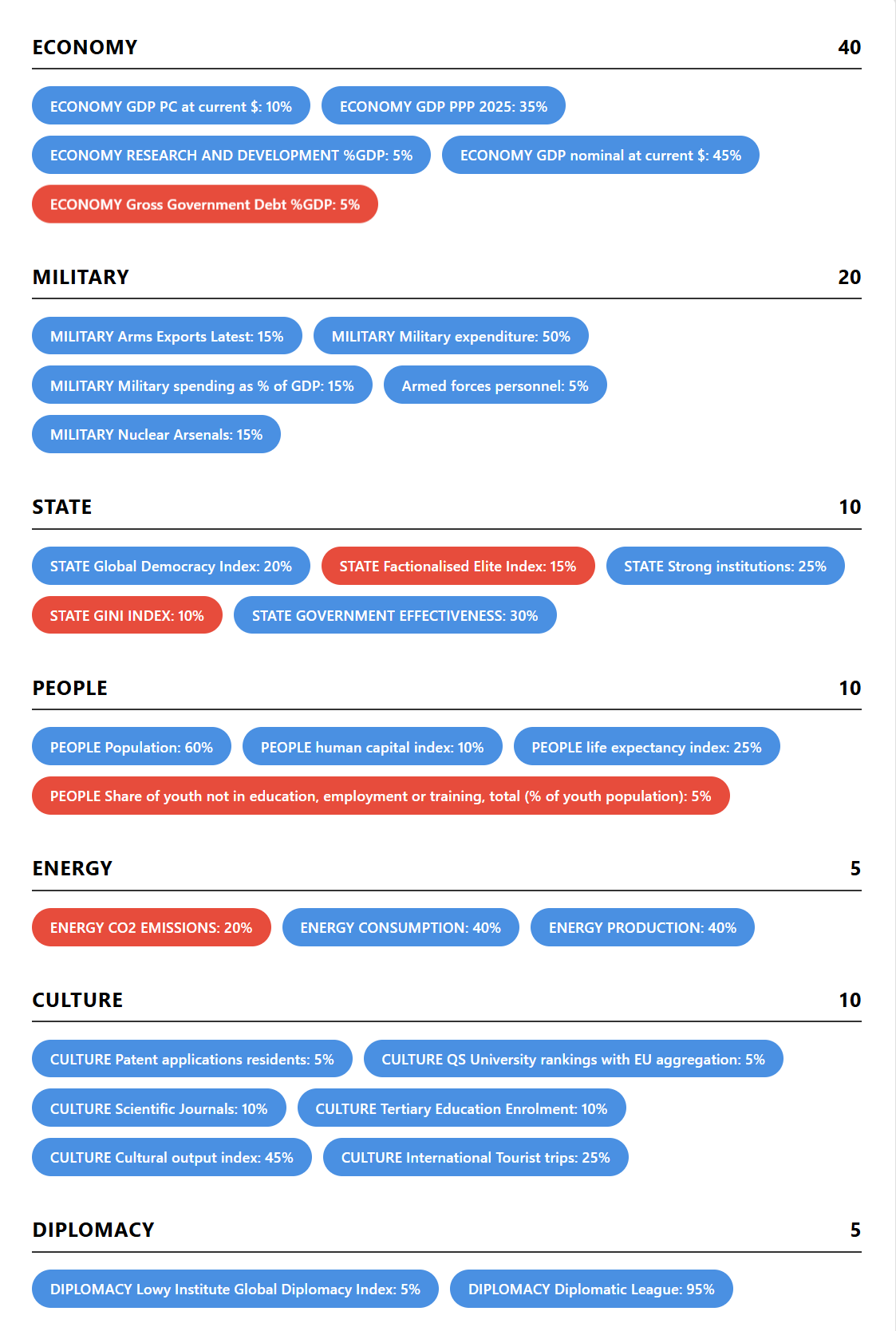
This graph shows how each league and game is weighted overall. These 30 games have been played in the 2025 season. In fact, every season since 1991. Blue games you want to maximise, red games you want to minimise. Blue is good to have more of, red is bad to have more of — so a nation wants high GDP and low debt, high life expectancy and low emissions.
So using the Smart Power Index we have tracked the fortunes of the top 11 countries on earth, identified their rises and falls, pinpointed their errors and successes so you can see how smartly or stupidly your leaders have led you.
Let's see the Leagues....
THE 7 LEAGUES: DETAILED BREAKDOWN
1. ECONOMY LEAGUE (40% Weighting)

See the rise of China, soaring after 1997 and 2008. The rise of Europe, nudging ahead in the same years. India mounting a late charge this decade.
But see how France and Japan have struggled in the economy league during the last decade, poor growth stifling their power.
See the Economy League in detail here.
2. MILITARY LEAGUE (20% Weighting)
See how the West slept whilst India soared up the military league and China and Russia held their own.
See the Military League in detail here.
3. STATE POWER LEAGUE (10% Weighting)
Economic stagnation has not affected the quality of France and Japan's state power but, despite relative economic success, the British and American systems have taken a surprising hit.
See the State League in detail here.
4. PEOPLE POWER LEAGUE (10% Weighting)
Look how India has risen and how everybody else has slid. The UK flatters to deceive as others lose their games.
See the People League here.
5. ENERGY POWER LEAGUE (5% Weighting)
The story here is the rise of China and India in energy production and consumption. But it is fall of the UK and the EU that is noteworthy as North Sea gas and oil diminishes and Russian supplies are suspended.
See the Energy Power League here.
6. CULTURE POWER LEAGUE (10% Weighting)
The story here is the rise of China and the decline of France as China's educational and scientific achievements feed through.
See the Culture Power League here.
7. DIPLOMACY POWER LEAGUE (5% Weighting)
Diplomatic power reveals the extraordinary rise of China (again) finally overtaking the US, the recovery of the UK and the fall of Russia.
See the Diplomatic Power League here.
SMART POWER SCORE
China - Score: 9/10 Chinese power integration across domains approaches systematic perfection. Economic strength enables military modernization, military power secures economic access, technological advancement facilitates diplomatic influence, and cultural projection supports strategic objectives. This creates multiplicative rather than additive effects.
USA - Score: 7/10 American power integration remains world-class but shows signs of deterioration. Military capabilities enable economic access, economic strength funds technological leadership, and cultural influence facilitates diplomatic success. However, domestic polarization increasingly constrains integration effectiveness.
EU - Score: 4/10 European power remains fragmented across national boundaries and institutional divisions. Economic strength doesn't translate into military capability, cultural influence lacks strategic direction, and diplomatic efforts often work at cross-purposes.
India - Score: 6/10 Indian power integration shows promise but remains underdeveloped. Their demographic advantages and technological capabilities haven't been effectively leveraged to amplify economic and military potential.
UK - Score: 4/10 British power shows resilience despite resource limitations. Their cultural influence (BBC, universities, monarchy) amplifies diplomatic impact far beyond economic or military capabilities. Financial services provide economic leverage that extends political influence, while intelligence capabilities (Five Eyes alliance) multiply security effectiveness. However, Brexit has disrupted European integration while failing to unlock equivalent global alternatives. Like a experienced midfielder who lacks pace but compensates through positioning and passing ability, Britain maximises limited resources through tactical sophistication. Their soft power projection remains world-class, but hard power constraints increasingly limit strategic options.
The Summing Up
Strategic Analysis
The League of Nations data reveals the most significant power transition since World War II: China's systematic displacement of American global leadership. This transition resembles the tactical evolution from catenaccio to total football - same objectives, fundamentally different approaches to achieving dominance.
China's success stems from strategic coherence maintained across decades, systematic investment in capacity building, and superior adaptation to 21st-century competition dynamics. Their model emphasizes state-directed development, technological sovereignty, and long-term planning - advantages that compound over time like compound interest in geopolitics.
America's relative decline results not from absolute weakness but from strategic drift and domestic dysfunction.
Europe faces the classic middle-age crisis: neither young and hungry nor old and wise, but trapped between historical glory and contemporary irrelevance. Without dramatic structural reform, they risk becoming geopolitical Serie A - respected but no longer globally competitive.
India represents the tournament's greatest opportunity and risk. Their demographic dividend and technological capabilities position them like Manchester City pre-Guardiola: all ingredients for greatness requiring exceptional leadership to realize potential.
Britain's strategic position embodies the broader Western dilemma in acute form. As the architect of the global system that China now challenges, the UK faces the painful reality that their imperial legacy provides little advantage in 21st-century competition. Their Brexit gamble - choosing sovereignty over scale - reflects either masterful long-term positioning or catastrophic strategic miscalculation. The mathematics suggest the latter: while the EU maintains collective strength despite institutional limitations, Britain's isolation threatens continued mid-table, middle-power status. Like a football club that sells its best players to avoid financial constraints while competitors invest in infrastructure, Britain has chosen short-term autonomy over long-term competitiveness. Their challenge mirrors that of all medium powers: how to maintain relevance when superpowers operate in a different competitive tier entirely.
Machiavelli's Smart Power Solutions
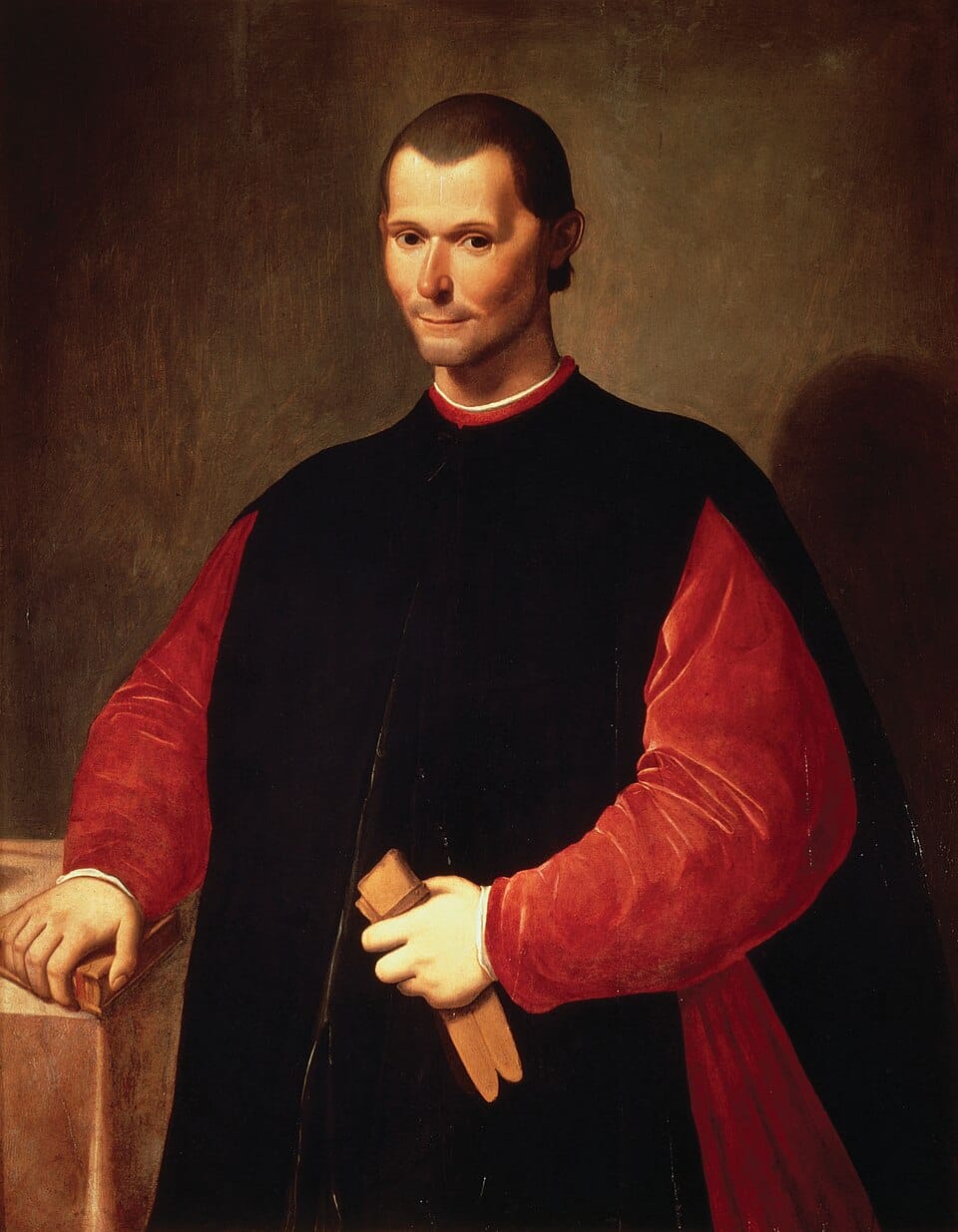
For China: Maintain strategic coherence while avoiding overconfidence that historically undermines dominant powers. Develop genuine soft power capabilities to complement hard power achievements. Address demographic challenges through immigration and productivity improvements. Resist strategic overextension by prioritising core interests over peripheral expansion.
For the USA: Restore domestic political stability to enable long-term strategic planning. Invest heavily in infrastructure, education, and technological leadership to maintain competitive advantages. Strengthen alliance systems while reducing unnecessary global commitments. Reform political institutions to reduce polarisation's strategic costs.
For the EU: Implement genuine integration in defence, technology, and fiscal policy to achieve scale advantages. Reform institutional structures to enable rapid decision-making during crises. Develop strategic autonomy capabilities while maintaining transatlantic partnership. Address demographic decline through immigration and productivity enhancements.
For India: Accelerate infrastructure development and manufacturing capacity to unlock economic potential. Strengthen state capacity across all domains, not just selected excellence areas. Leverage demographic advantages through education and urbanisation investments. Develop military capabilities commensurate with economic and diplomatic ambitions.
For Britain: Accept medium-power status while maximising competitive advantages within that constraint. Leverage cultural influence, financial expertise, and institutional quality to punch above economic weight. Like a football club that cannot compete for the biggest transfers, focus on developing talent, tactical sophistication, and sustainable competitive advantages rather than pursuing unsustainable ambitions.
China has chosen to be feared through systematic capability building. America must decide whether to accept gradual decline or fight for continued relevance. Europe must choose between irrelevance and painful reform. India must choose between potential and reality. Britain must choose between nostalgic delusion and strategic realism - between the fantasy of restored greatness and the mathematics of middle-power limitations. Their choice will determine whether they remain relevant players in the great game or become historical footnotes in others' victories.
The league table never lies - and 2025 marks the year when the impossible became inevitable.
Get Friday's Economy Situation Report in full?