

Measuring national power has long challenged scholars of international relations. Harvard professor Joseph Nye's concept of "smart power"—the strategic integration of coercive and persuasive capabilities—provided a theoretical framework, but lacked operationalisation. The League of Nations system addresses this gap through a quantitative methodology built on 30 (and many more) distinct metrics organised across seven power dimensions: Economy, Military, State, People, Energy, Culture, and Diplomacy.
The framework employs differential weighting to reflect each dimension's relative importance in contemporary international relations. Economic factors account for 40% of total power assessment, military capabilities 20%, with the remaining 40% distributed across state effectiveness, demographic vitality, energy security, cultural influence, and diplomatic reach. This allocation reflects empirical observations about which capabilities most reliably translate into geopolitical outcomes.
The system draws on established indices from institutions including the World Bank, IMF, International Institute for Strategic Studies, and various UN agencies. By aggregating these data sources through consistent methodology, it produces comparable rankings across 168 countries from 1991 to present, with forecasts extending to 2030.
This approach reveals that sustainable power emerges not from excellence in a single dimension, but from balanced development across multiple capabilities. The methodology provides both diagnostic assessment of current standings and analytical insight into trajectories of rise and decline.
1 Model
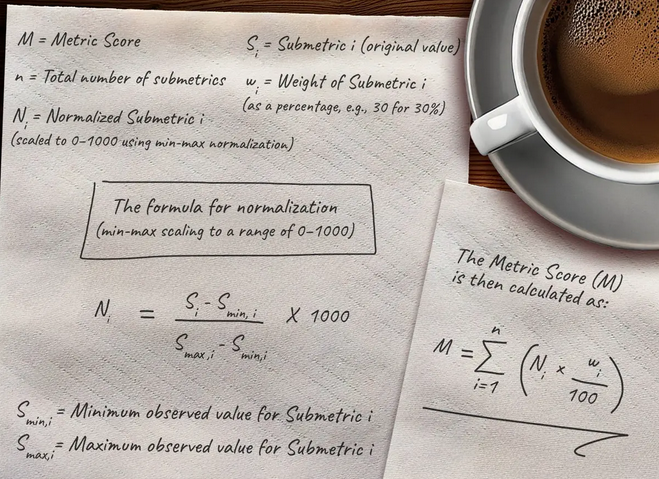
The League of Nations uses a composite index model that combines several well-established statistical techniques:
Primary Statistical Model: Min-Max Normalization with Weighted Aggregation
Key Components:
- Min-Max Scaling (0-1000 range)
- Formula: N = ((S - S_min) / (S_max - S_min)) × 1000
- This is a standard linear normalization technique that transforms raw data to a common scale
- Weighted Linear Aggregation
- Formula: M = Σ(N_i × w_i)
- This creates a composite score by combining normalised submetrics with assigned weights
Statistical Model Classification:
This approach is most similar to:
- OECD's Better Life Index methodology
- Human Development Index (HDI) calculation framework
- Global Competitiveness Index structure
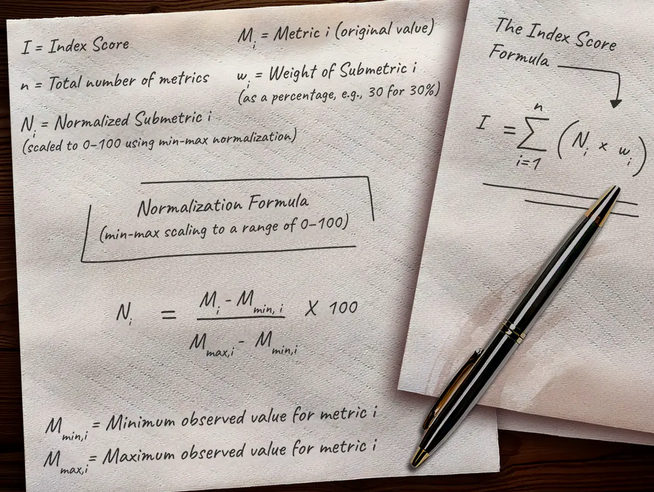
It's a proven approach for creating league tables and international rankings because it:
- Ensures all metrics contribute equally regardless of their original units
- Maintains transparency in weighting decisions
- Allows for easy interpretation and comparison across nations
- Prevents any single metric from dominating due to scale differences