Europe built a long-term strategy to cut fossil-fuel dependence, price pollution and help households make the switch. Now the timetable is slipping and the bargain is back on the table. Leaders can claim a fight against higher bills today; the danger is leaving Europe exposed to the same expensive fuels tomorrow. Moscow has reasons to welcome the hesitation.
What's the problem?
Europe wants cheaper energy. It keeps arguing over the machinery meant to make it less dependent on expensive fossil fuels. At the 15–16 October 2026 summit, EU leaders asked the Commission to examine further short-term price measures and reassess the design and safeguards of ETS2, the new carbon market for heating and road-transport fuels. The official summit account also defended carbon pricing and called for faster deployment of clean energy, grids, storage and efficiency. The strategy survived in the text. The political fight over delivering it remained wide open.
According to Euronews's summit reporting, Czechia, Slovakia, Hungary and Poland, joined by Italy and to a lesser extent Greece, pushed to revisit carbon-market rules. Finland, Denmark and Sweden resisted. The report describes much of the push as a message to domestic audiences, with no new practical relief emerging from the energy argument. That is the uncomfortable exchange: a long-term strategy put back on the bargaining table for a short-term political dividend. A drafting victory does not pay a gas bill.
The strategy has a coherent logic. ETS2 makes fuel suppliers buy allowances for the emissions associated with their fuels, encouraging cleaner choices while raising money for climate action and social support. Suppliers can pass costs on to customers, which makes accessible alternatives and household protection essential. A pensioner in a draughty home cannot switch heating systems on a minister's timetable. The policy needs insulation, cleaner heating and practical transport options to arrive alongside the price signal.
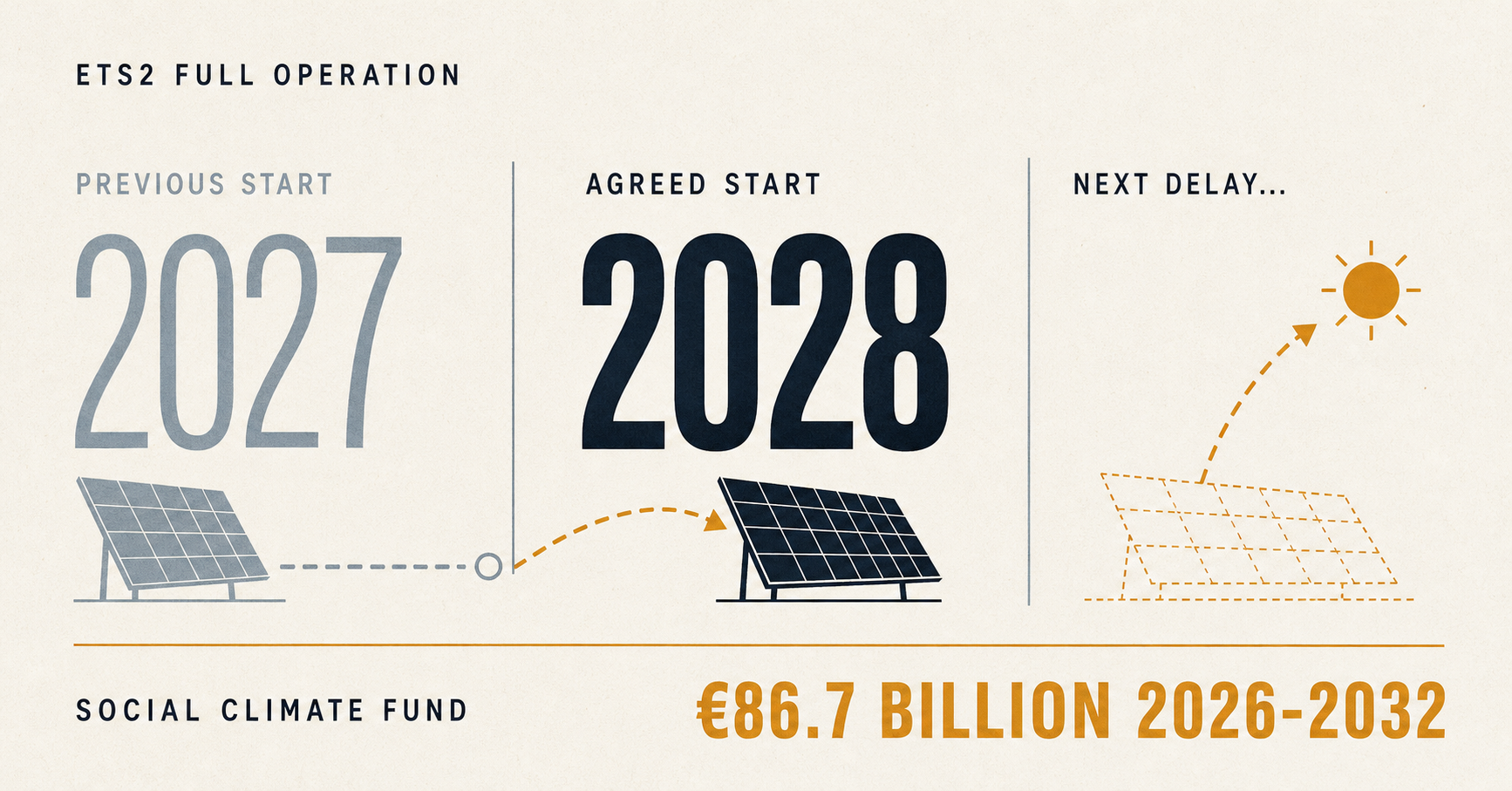
The retreat in the timetable is already real. The Council's final adoption of the revised Climate Law on 5 March 2026 moved ETS2's full operation from 2027 to 2028. October's summit did not enact that delay, and ETS2 is not yet a carbon charge on today's household fuel consumption. The present danger is that one concession becomes the opening bid for the next. Europe risks spending the breathing space on another argument.
Is history repeating itself?
There is a useful modern warning much closer to home than Fukushima: Britain's decision to trim energy-efficiency obligations to ease bills.
In December 2013, David Cameron's coalition announced a package intended to cut the following year's average household energy bill by £50. It included a proposed 33% reduction in one carbon-saving component of the Energy Company Obligation. Dedicated support for vulnerable households was retained; this was not the abolition of all green spending. But the Commons Library's review records that the number of ECO measures fell 41% in April 2014 after the changes were introduced. The warning is concrete: cutting the cost of an efficiency programme can also cut the work it delivers. A smaller levy gets noticed immediately. The insulation that never reaches a wall is harder to photograph.
The older mirror is Philip II's Spain. His payment suspensions in 1557 and 1560 involved debts inherited from Charles V; later crises exposed the strain between military commitments and available cash. Yet research by Mauricio Drelichman and Hans-Joachim Voth challenges the familiar story of a financing system simply collapsing: lenders continued to profit, and lending resumed after restructurings. The useful lesson is about matching commitments to dependable finance. An impressive strategy still has to pay its way.
Neither comparison predicts Europe's fate. A carbon-market delay is not a sovereign default, and an efficiency obligation is not an emissions market. They identify the question leaders should answer before claiming a saving: what future protection disappears with today's cost?
Whose plan is better?
The stronger plan is to reduce Europe's exposure to fossil-fuel shocks while protecting people through the change. That links climate policy to energy security and household resilience. Its credibility rests on delivery: warm homes, workable transport and electricity that can reach the places needing it. The League's judgment is that repeatedly reopening the timetable weakens that offer. But a well-developed strategy still needs revision when evidence shows that its safeguards or delivery are inadequate. The test is whether a change improves the route to the long-term goal, with its costs funded and explained. A government demanding more time should say what it will build with it.
Whose policy is better?
The Nordic defence of a predictable carbon market has the stronger strategic case, provided it comes with effective household support. The countries pressing for relief are raising a real distributional problem: people with little money and few alternatives cannot respond like investors with spare capital. The answer should join targeted bill support to faster investment, with safeguards against disruptive price swings. The EU has already taken a practical step: in February, the Commission and European Investment Bank announced a €3 billion lending facility to bring forward investment in cleaner buildings and transport. It offers early finance backed by future auction proceeds. Governments should be judged on how much usable help they deliver with it.
Whose performance is better?
Europe's record needs an honest scorecard. The Social Climate Fund's current public framework still provides for €86.7 billion over 2026–2032, including national contributions, supporting vulnerable households, transport users and micro-enterprises. The fund is designed to operate before ETS2's full launch. Moreover, the Commission's July auction-timetable notice says ETS2 auctions will start in January 2027. These arrangements matter: a delayed start for the carbon obligation does not mean every source of finance has been switched off. The performance test is whether the money becomes completed improvements before households face the new charge.
Russia's stake is easier to see than to score. CREA's September 2026 report, published on 16 October, estimates Russian fossil-fuel export revenue at €625 million a day, averaged across that month. These are export earnings from global customers, not a measured daily payment into the Kremlin's war budget. They illustrate the continuing scale of the fossil-fuel business. The strategic inference is that a slower European move away from those fuels can favour exporters, including Russia, by prolonging demand and exposure to price shocks. That does not establish Russian involvement in the Brussels argument or put a euro value on Moscow's benefit from it. Europe is quite capable of delaying its own escape route.
Learning from the past, what is the solution?
Britain's experience puts the delivery question first; Spain's puts the financing beside it. The League proposes three commitments, with deadlines and results that voters can check:
- The Commission should publish the requested ETS2 reassessment by April 2027, showing household impacts across income groups, heating systems and transport needs, alongside a funded plan for the safeguards. Success means identifying who faces an unaffordable burden and how support reaches them before the charge does. A lower carbon price alone is not a complete measure of success.
- EU governments and the European Parliament should defend the agreed 2028 start and the Social Climate Fund's funding framework. Any proposed change should disclose its effects on revenues, emissions and household support, with a named source for any replacement money. By the end of 2026, governments should publish clear national delivery schedules. A fresh delay should have to earn its case.
- Member-state governments should turn the breathing space into visible improvements during 2027, combining targeted relief with renovation, cleaner heating and affordable transport. Publish quarterly figures for homes improved, eligible households reached, support paid and changes in household energy burdens. Count the work, not the announcements.
How much will it cost?
There is no established total bill for the summit's hesitation. The European Parliament research service's current account identifies €65 billion in EU funding for the Social Climate Fund, with national contributions taking the combined amount to at least €86.7 billion. Those are financing provisions, not proof that the money has reached households. An EEB warning issued in November 2025 projected roughly €50 billion in forgone auction revenues and around €10 billion less for the fund under the delay. That warning predates the subsequent arrangements for early auctions and the current published funding framework; it cannot serve as an invoice for this October's summit. Any additional relief must be costed against the investment it protects, the revenue it replaces and the future fuel exposure it reduces. Neither delay nor delivery comes free.
What is the cost of doing nothing?
Europe can keep its targets on paper while making the route towards them less credible. Every further concession needs a replacement: another investment, another funded measure, another way to cut fuel use. Without one, the likely result is a longer stay in the same costly dependence that governments say they want to escape. The long-term strategy deserves a fair test of delivery. Households deserve help they can use. Short-term political gains should be measured against both. Europe can postpone a carbon charge. It cannot postpone the next energy shock. Moscow has reasons to be patient.