Corruption Match of the Day: the top takeaways
1 What’s the score now?
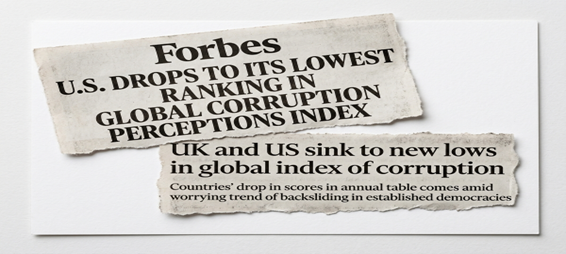
Remember the days when Anglo-America was the beacon of clean government in a world of murky states? In 2016 the UK was 11th in the world on 83, sandwiched between pure-as-the-driven-snow Luxembourg and Germany. The US stood 15th on 76.
What a decade does to the solid chaps of the White House and Whitehall. The two old captains of the rules-based liberal order are not top of the holier-than-though league any more. The US has dropped 12 points, the UK, 13. Worse, the gap between autocratic China and, democratic hegemon, the United States has narrowed from 41 points to 21 points.
They’re losing games, dropping points. Drifting towards mid-table, leapfrogged by minnows, hoping no-one’s looking, their model is looking tired.
Well, look at this.
The Corruption Perceptions Index, published annually by Transparency International, is not a moral report card. It reflects state capacity — the ability of a government to enforce laws, mobilise resources, and execute strategy. It researches 10 corruption sins including bribery, diversion of public funds, misusing public office, weak integrity mechanisms, excessive red tape, poor whistleblower protection and state capture by narrow vested interests.
And by these measures, the world's two most powerful English-speaking democracies are in a death spiral. The end result?
2 Plunging down the League: When Estonia Overtakes the Empire
Humiliation. The United States has fallen to 29th place — below Lithuania, Barbados, and Uruguay. The United Kingdom has dropped to 20th, trailing Hong Kong.
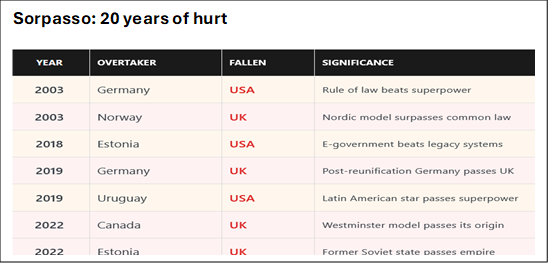
Ten years ago the United States ranked 19th in the world for clean government; today it ranks 29th. Britain slid from 7th to 20th in the same period. Other nations have overtaken them. Germany, Estonia, Ireland, and the UAE have all leapfrogged the United States and United Kingdom. The minnows have not stolen a lucky point at Anfield; they have built better systems.
3 Bad form
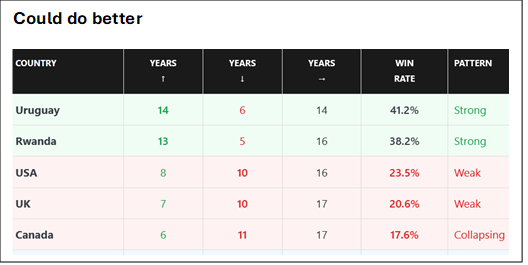
The form guide is brutal too. The United States has seen its score rise in just 8 out of 34 measurable years since 1991 — a 23.5% consistency rating. Britain manages 20.6%. In football terms, the badge is still famous, the wage bill is still large, but the pressing has gone, the recruitment is suspect and the crowd has started to suspect the manager is bluffing.
This is really bad news for Western democracies. Britain and America still speak the language of integrity while looking suspiciously like clubs living off old highlights.

And the public have noticed. Red is negative opinion about the country, yellow is neutral, green is positive.

See the world! You're not limited to just the top countries. Discover the fate of each and every country in the world in The Corruption League of Nations here.
So now you know the score, the rank, the form and public opinion, what do you think will happen next?
Can you forecast the future?
4 What next?
Will this collapse in rank, score and form will the UK and US keep on plunging in the corruption perceptions index?
Where will they be in 2030?
Draw your forecast with cursor or finger
The forecast is dire.
You need to know what’s going wrong and how to fix it.
You’re a spectator now. Now you know the official forecast, you've got to do something. Join the team.
You'll get 7 smart rules of power to help you win.
Your mission, should you choose to accept it, is to find out why we lost and then play the Powergame to see if you could do better.
Click here to join the briefing room. You will get a confidential match report before the game!
2 THE SEVEN SMART RULES: The Briefing Room: Post-match analysis
| THE SEVEN RULES OF POWER | |
|---|---|
| ⚽ GAMEPLAN · 1st Half — Rules 1 & 2 | |
| 1 | Do you/they have a plan? |
| 2 | Is your/their leader strong? |
| ⚔️ ATTACK · 2nd Half — Rules 3 & 4 | |
| 3 | Is your/their state capable? |
| 4 | Are your/their policies right? |
| 🛡️ DEFENCE · Injury Time — Rules 5 & 6 | |
| 5 | Are you/they innovating on rules 1–4? |
| 6 | Are internal and external rivals undermining you in rules 1–4? |
| 🏆 RESULT · Final Whistle — Rule 7 | |
| 7 | Post-match analysis — did the gameplan work? |
| Source: League of Nations Smart Power Framework | leagueofnations.co.uk | |
When you play the game you need a confidential briefing before.
It's a bad result. No two ways about it.
The forecast is even worse.
On current form, the United States and United Kingdom will fall to 58–60 CPI points by 2030 — scrabbling around 40th place alongside Botswana and Belgium. A decade ago, both nations sat in the top fifteen. If this were a football club, the board would have sacked the manager in November.
The question is why.
Transparency International's 2025 report is not a jeremiad. It is a forensic autopsy on countries who have lost their way. Distilling all its conclusions through the 7 rules of power shows that the diagnosis is grim. Like in any football game you need a smart gameplan, a strong attack and a sturdy defence. The US and UK are being outplayed in every department of the game — vision, execution, tactics, and result.
Match Report:
USA & UK vs THE ELITE TRIO
Denmark 90 · Singapore 84 · Estonia 76 · UK 71 · USA 65
Transparency International game | March 2026
1 ⚫ GAMEPLAN —Team talk
Rules 1 & 2: What is the anti-corruption plan? Who's delivering it?
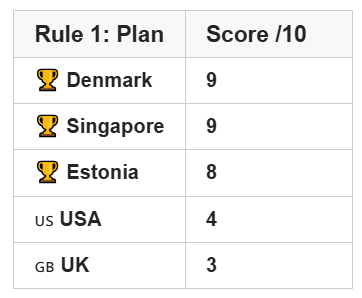
Denmark 9 | Singapore 9 | Estonia 8 | USA 4 | UK 3
Rule 1: Do You Have A Plan?
This game was lost from the beginning. The USA has no federal anti-corruption plan. Fifty state rulebooks, a $4.3bn lobbying industry writing everyone else's playbook, and a revolving door so well-oiled Halliburton executives write Pentagon contracts. The UK? "Global Britain" was the plan — it ended in £15bn of VIP-lane PPE deals, untendered contracts, and a government that confused sovereignty with impunity.
Rule 2: Is Your Leader Strong?
The management is lost. The USA fielded five presidential transitions since 2012, Supreme Court appointments treated like transfer-window panic buys, and a Congress where dark-money donors pick the starting eleven. The UK? Five Prime Ministers in eight years. Liz Truss lasted 49 days — shorter than a pre-season tour. A Serious Fraud Office so underfunded it loses more cases than it wins.
Meanwhile, Frederiksen (Denmark), Wong (Singapore), Kallas and now Michal (Estonia) — three leaders sharing one trait: institutional insulation from short-term patronage. Long mandates. Meritocratic cabinets. Ministers who resign at the first whiff of scandal, not the tenth.
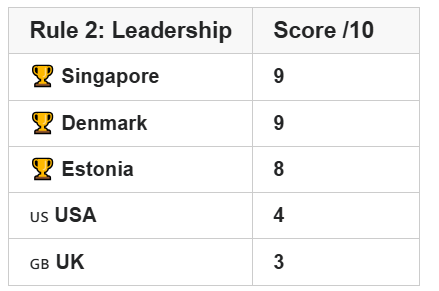
🟨 GAMEPLAN : Elite Trio 26 pts | USA 4 pts | UK 3 pts
2 ⚫ ATTACK — 1st half
Rules 3 & 4: Is the state strong enough to win the game? What are our tactics?
Here is your team. This is about your state. Tacking corruption needs a strong state.
Rule 3: Is Your State Capable?
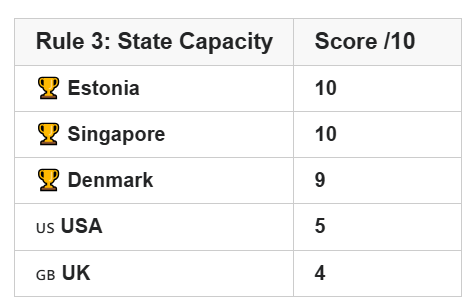
This match is about executing the plan, if there is one. Of the 7 smart powers, your state is your playmaker, starting the attack. He's lost form since 2016. In the G20, US down to 12th, the UK to 8th by 2035. In both the US and UK, the state is being quietly broken up from the inside — and the tactics have been captured by the interests they were designed to contain.
Not so with the oppo. Estonia opened the second half with a devastating counter-attack. While the USA debated whether emails were legally discoverable, Estonia had already digitized everything — permits, payments, procurement — logged, hashed, immutable, real-time.
Singapore deployed all state power without a single point of friction: zero red tape, meritocratic civil service. Their state processes billions with near-zero leakage. Denmark's tax authority uses AI to flag anomalies; infrastructure procurement has open APIs for citizen auditing.
Starting from the mid-2010's, the USA's state has become Balkanized — federal versus state jurisdiction battles, agencies captured by revolving-door appointees, and ranked #13 for infrastructure despite being the world's richest nation. The UK? Local councils bankrupt (Birmingham, Croydon), HMRC unable to recover £42bn in tax fraud, and a Companies House that registered 500,000 shell companies before anyone noticed.
Is corruption a factor? Institutional independence is the central casualty. Seventeen Inspectors General were dismissed in a single night in the United States. In Britain, the revolving door between the Cabinet Office and the lobbying industry has become so well-worn it qualifies as a formal career path.
Rule 4: Are Your Policies Right?
Even if your plan, leader and state matched the best in class, the tactics are all wrong anyway. Singapore's policy mix is the textbook Smart Power balance: 3.1% GDP on defence, $300bn foreign reserves, 80% public homeownership, zero income tax below $20k, and a death penalty for serious corruption. Tough, balanced, effective.
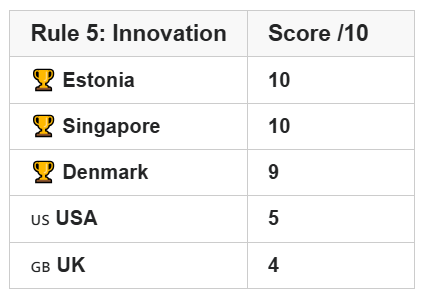
Estonia won Rule 3 before halftime. While the USA debated digital procurement, Estonia had already digitized government—every permit, payment, and contract logged, hashed, immutable. Innovation: 10/10. Singapore deployed all seven smart powers in perfect sync—zero red tape, meritocratic civil service, green finance hub, death penalty for corruption above $100k. State capacity: 10/10. Denmark processes $180bn annually with near-zero leakage, using AI to flag anomalies and open APIs for citizen auditing — Total Football governance with every department pulling in the same direction.
The USA's policy is broken. The Foreign Corrupt Practices Act — America's primary instrument for prosecuting overseas bribery — was suspended in 2025. Policy has not merely failed to point at the right target. It has been aimed deliberately away from it, by the people with the most to lose from accurate marksmanship.
The UK invented beneficial-ownership registers, then assigned 4,000 investigators to 500,000 shell companies. Both nations have the tools of the 1945–1991 cycle—FOIA laws, free press, independent courts. Neither has built the systems of the 2020–2050 cycle: algorithmic enforcement, real-time transparency, API-driven accountability.
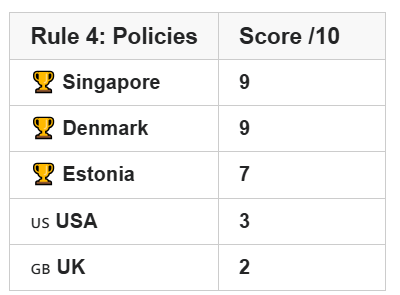
🟨 HALF-TIME: Elite Trio 54 pts | USA 16 pts | UK 12 pts
3 ⚫ DEFENCE — 2nd half
Rules 5 & 6: Can you innovate? What are the opposition's tactics?
Rule 5: Are You Innovating?
Worse still, the tactics are out-of-date. Estonia won Rule 5 before 2010 and hasn't looked back. Blockchain voting. Digital ID. API-driven public services. $400m digitizing government — and climbing the CPI table every year since. Singapore leads green-finance innovation: first ASEAN carbon credit exchange, green bond market, and fintech regulation that balances growth with integrity. Denmark pioneered 50% electricity from wind, carbon-neutral capital (2025 target), and pension-fund transparency tools that smaller nations now copy.
The USA invented FOIA, produced Pulitzer-winning investigative journalism, and built Silicon Valley — then left 40% of federal procurement on paper forms. The UK invented beneficial-ownership registers in 2016, the most powerful anti-corruption tool of its generation — then assigned 4,000 investigators to 500,000 shell companies and called it a strategy. Both nations have the ideas. Neither has the will to implement them at scale.
Rule 6: Are Rivals Undermining You?
Finally, the opposition are beating you at your own game. Singapore studied China's anti-corruption purge not as a morality play but as state-capacity warfare — Xi liquidating factional rivals to centralise power. Singapore's response: tighten their own systems preemptively. Estonia faced existential rival pressure — Russia's 2007 cyber-attacks, disinformation, hybrid war — and responded with NATO, EU integration, and digital resilience so robust that corruption became a strategic liability they simply couldn't afford.
The USA misread Rule 6 completely. China's anti-corruption drive was labelled "authoritarian purge" — a moral judgement that missed the strategic point entirely. Domestically, dark money captured the Supreme Court, oligarchs wrote Pentagon budgets, and lobbying hit $4.3bn annually. The UK's rival analysis was catastrophic: they identified Brussels as the enemy, missed the real threat — irrelevance — and handed Russia and China £100bn in annual money-laundering through a barely-supervised City of London. Rivals didn't need to undermine them. They undermined themselves.
| Rule 6: Rival Pressure | Score /10 |
|---|---|
| 🏆 Singapore | 9 |
| 🏆 Estonia | 8 |
| 🏆 Denmark | 8 |
| 🇺🇸 USA | 3 |
| 🇬🇧 UK | 2 |
4 ⚫ FINAL WHISTLE
Rule 7: Did the gameplan work? No
RESULT — RULE 7: AGGREGATE FINAL SCORE
| Rule | Best Score | USA | UK |
|---|---|---|---|
| R1: Plan | Denmark/Singapore 9 | 4 | 3 |
| R2: Leadership | Denmark/Singapore 9 | 4 | 3 |
| R3: State Capacity | Estonia/Singapore 10 | 5 | 4 |
| R4: Policies | Denmark/Singapore 9 | 3 | 2 |
| R5: Innovation | Estonia/Singapore 10 | 5 | 4 |
| R6: Rival Pressure | Singapore 9 | 3 | 2 |
| TOTAL /60 | Elite Trio avg: 54 | 24/60 | 18/60 |
Summing-up — Stupid Power: America and Britain are a hegemon and an ally really feeling the pressure. This game matters if your grand strategy is to defend the so-called “rules-based international order”. Across the whole game, in every department, at every level, the US and the UK were poor. No gameplan. No attack from the state. No defence against resistance. That is a strategic choice — made consciously or not, in full view of every rival, ally, and investor who is currently recalculating their exposure to both countries. The result is not a shock. The forecast is right. It is the only possible outcome of the preceding ninety minutes.
The League rankings confirm it, the 7 rules confirm it: America has fallen, minnows have a stronger state and a cleaner government. Since 2012, Xi Jinping has punished 1.5 million officials for corruption. Since 2020, the United States has prosecuted zero elite cases. The losers changed strategy every election, sold influence for access, and called the resulting coverage a media problem.
Full-time verdict: 🥇 Man of the Match: Denmark — playing tomorrow's game today.
Denmark won the league — 54/60 Smart Rules points, CPI #1 and rising. They understood the game: corruption is friction, and in the AI/green-energy cycle (2020–2050), frictionless states dominate.
Estonia rose 5 CPI points since 2020 by digitising faster than rivals can corrupt. Denmark held elite status despite populist headwinds. Both play the next game.
The USA (24/60) and UK (18/60) are in relegation form — defending 1945 systems in a 2025 world. Estonia spent $400m digitizing government. The USA spent $886bn on F-35s. Estonia's climbing. The USA isn't.
The table never lies. The whistle has blown.
The reason? The winners in this contest followed the rules. They share three characteristics that have nothing to do with current US and UK gameplans:
- they institutionalised anti-corruption rather than personalising it
- they prosecuted their own elites rather than protecting them, and
- they treated the CPI as a strategic instrument rather than a public relations inconvenience.
We don’t want to be declining now into a mire of state decay. How can we avoid it? What is the cost if we do nothing? Two choices: do nothing or copy Denmark, Estonia and Singapore
The price of the Danish solution is $2 billion a year — roughly what the United States loses to procurement fraud in a single quarter.
A manager is not judged on one game. He is judged on the season. He needs to know when, to change tactics and stifle opposition. Yes, the gameplan is outdated, the attack weak, the defence poor. But not only that, is the board lost, the manager misguided, the formation system failing? Have you past your peak irretrievably? Are sliding down the season without knowing it?
The 7 Smart Rules are exactly that — the match plan. Follow them well and you will win more games than you lose. The Elite Trio proves it: Denmark, Estonia and Singapore have followed all seven, consistently, for twenty years. They are top of the table.
The Bigger Picture
But ask yourself a harder question. How did they stay there?
By reading the season. By keeping ahead of the curve. Not by repeating the same match plan when momentum stalls. A great manager develops a sixth sense for the shape of the whole campaign. Knowing other teams are building specifically to take his position. They have studied his system. They know his vulnerabilities. They are coming for him.
That is exactly what China, Estonia, Singapore and the Gulf states are doing to the United States and the United Kingdom right now.
You've got to see the bigger picture. If your forecast is going to work you need to know where you are in the season, and change your plan.
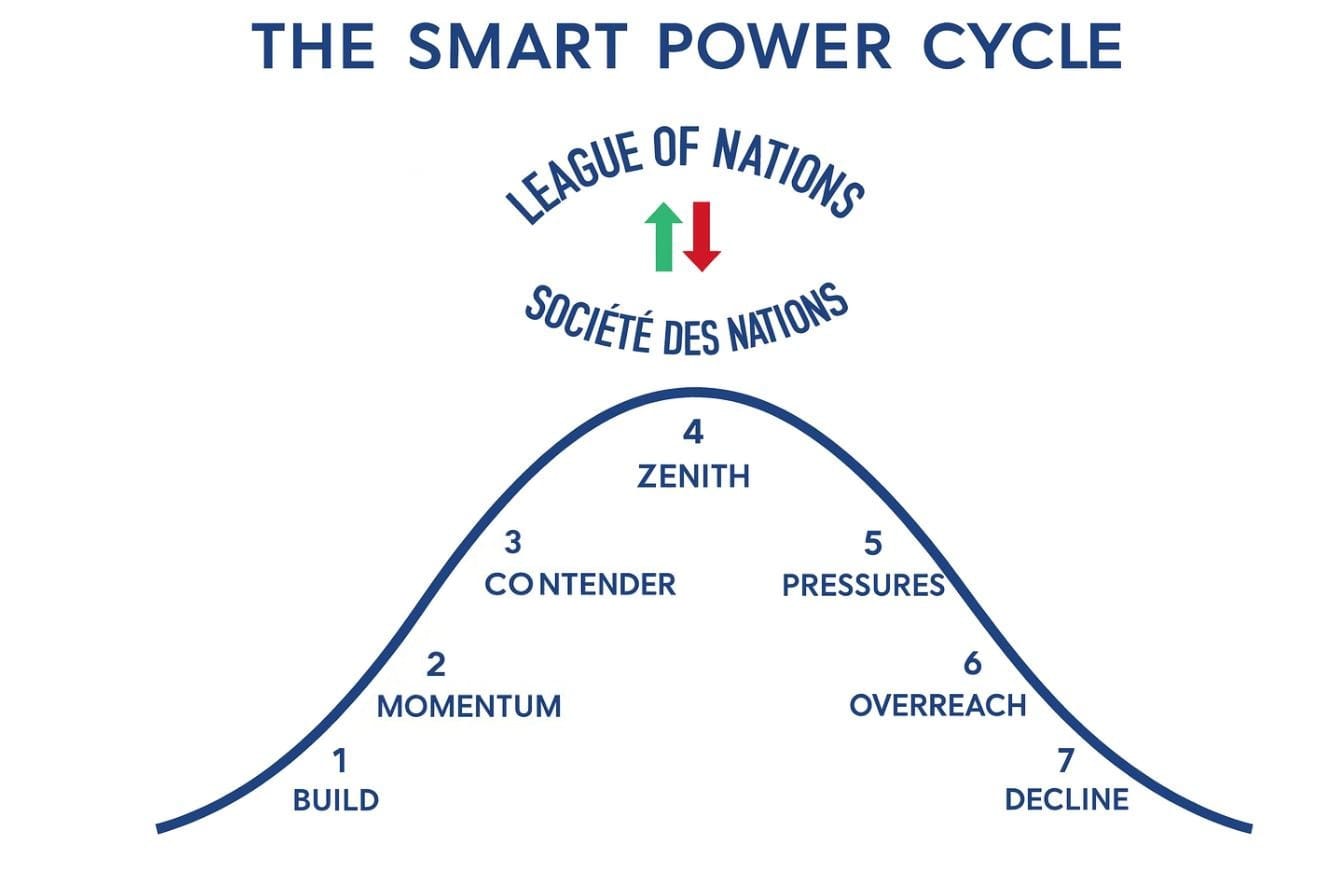
QUIZ — What stage of the Smart Power Cycle are the US and UK at?
At this stage of the Smart Season a manager has three choices.
- Do nothing: double down — spend more, shout louder, change nothing fundamental. That is overreach, and it accelerates the decline.
- Tinker: hold position — manage the pressure, hope it passes, tell the board it is a temporary dip. That is slow decline.
- Act: do what only the great ones do: change the system. Study the rivals. Innovate before he is found out. Rebuild while there is still time.
Because you need to see the bigger picture:
- Declining corruption index results are matched by declining state power
- Declining state power means weak government, stronger elites, more inequality like
- Weak government, stronger elites, more inequality means the proberty needed for trust, the state need to enforce the rule of law and the nation that embodies it have lost the plot.
Because corruption is not a policy failure. It is the fever that tells you the disease is already inside the walls — the symptom of a deeper rot that every hegemon develops when the structures that built it begin to resist the reforms that would save it. You need to understand not just the score and the rules. You've played the game. Now you must play the season.
The Situation Report does that for you.
Use the time machine: You forecast the future from the past. Change history.
Learn from history. Two leaders facing corruption, pressures stage, losing the state league, not playing the rules, facing decline. One won the world with smart power. One lost through stupid power. They both knew the price, one paid it.
Who were they and what did they do?
How long the window stays open. What happens when it closes.
And what two leaders, facing this precise moment three centuries ago, chose to do about it.
One saved his country.
One lost his empire.
Sign-up to the Situation Report and see whether you're winning or losing.