1 SMART POWER — THE SCORE: TOWARD THE RELEGATION ZONE
Deploy the power: What’s the score now?
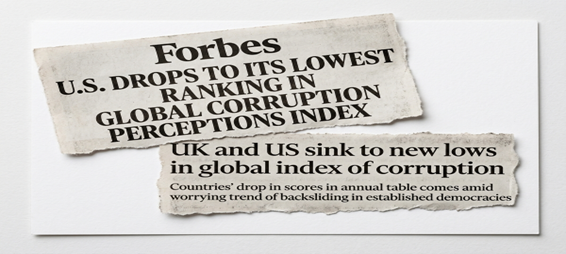
Remember the days when Anglo-America was the beacon of clean government in a world of murky states? In 2016 the UK was 11th in the world, sandwiched between pure-as-the-driven-snow Luxembourg and Germany. The US stood 15th. What a decade does to the solid chaps of the White House and Whitehall. The two old captains of the liberal order are not top of the league any more. They are drifting towards mid-table, muttering about bad refereeing.
The Corruption Perceptions Index, published annually by Transparency International, is not a moral report card. It is a leading indicator of state capacity — the ability of a government to enforce laws, mobilise resources, and execute strategy under pressure. It covers 10 core manifestations of corruption including bribery, diversion of public funds, misusing public office, weak integrity mechanisms, excessive red tape, poor whistleblower protection and state capture by narrow vested interests.
And by these measures, the world's two most powerful English-speaking democracies are in a death spiral. The end result?
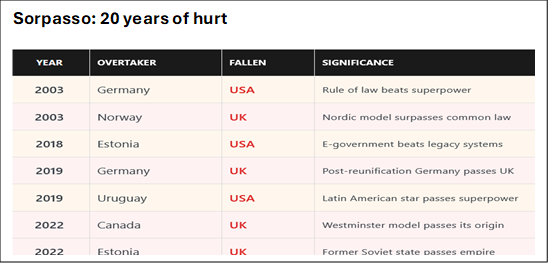
When Estonia Overtakes the Empire
Humiliation. The United States has fallen to 29th place — below Lithuania, Barbados, and Uruguay. The United Kingdom has dropped to 20th, trailing Hong Kong.
Ten years ago the United States ranked 19th in the world for clean government; today it ranks 29th. Britain slid from 7th to 20th in the same period. Other nations have overtaken them. Germany, Estonia, Ireland, and the UAE have all leapfrogged the United States and United Kingdom. The minnows have not stolen a lucky point at Anfield; they have built better systems.
Bad form
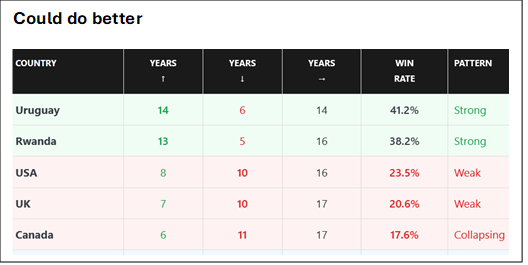
The form guide is brutal. The United States has seen its score rise in just 8 out of 34 measurable years since 1991 — a 23.5% consistency rating. Britain manages 20.6%. In football terms, the badge is still famous, the wage bill is still large, but the pressing has gone, the recruitment is suspect and the crowd has started to suspect the manager is bluffing.
China has risen 20 spots adding 8 points to its score since 1991. The gap between China and the United States has narrowed from 41 points to 21 points. At current trajectories it closes to single figures by 2032
This is really uncomfortable for Western democracies. Britain and America still speak the language of integrity while looking suspiciously like clubs living off old highlights.
Does all this matter? History offers an unequivocal answer: Yes. Because the index is not a moral sermon. It is a proxy for state capacity: whether laws bite, contracts mean something, public office can resist private money and institutions remain stronger than the people temporarily occupying them.
Smart Power says that corruption doesn't kill nations through scandal. It kills them through State collapse. As night follows day. It destroys them mechanically—like rust eating through an engine. First, meritocracy dies. Then, long-term planning becomes impossible. Finally, the State itself—the machine that enforces laws, mobilises armies, builds infrastructure—stops working.
What next? Corruption eats your state’s power
Will the UK and US keep on plunging in the corruption perceptions index? Afraid so. If the current trend continues the USA and the UK will fall to 58-60 points by 2030, scrabbling over 40th spot with Botswana and Belgium.
And that is exactly what is happening.
The forecast is dire. But maybe the US and UK’s strong state system can withstand a spot of corruption when the elites cash in on a diminishing pie?
And yet there sits Xi Jinping treating corruption as a matter of regime discipline, firing 1.5 million officials since 2012. Meanwhile, America has prosecuted zero elite corruption cases since 2020.
Transparency International see leaders look the other way as democracy withers, elites eat away at institutions, governments fail, inequality rises. States lose legitimacy and are overthrown-from without, or within.
It’s worse than you think
Look at this.
This shows where the US and the UK are going in the G20 state league. It shows the USA and the UK declining in State Power over this exact period. The USA falls from #7 to #8 and the UK from #3 to #6 in overall power.
London and Washington might say: Yes, corruption perceptions might look bad, but a bit of donor chumminess and a few unprosecuted elites are merely the froth of democracy. The state power decline doesn’t seem that dangerous. Falling to 6th and 12th enables recovery. We’re ok really.
I'm alright, Jack?
You're not. Look at this bubble chart. This is the real story. This shows the direction of travel for the great rule of law states.
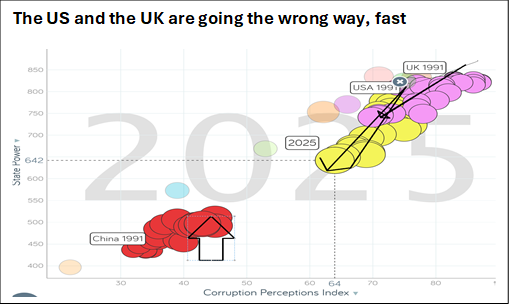
At the same time as they have been plunging down the corruption Index, Britain has shed 80 State Power points since 2003. America has shed 141 — nearly double Britain's power loss in absolute terms. Those arrows show the link between corruption and state decline starkly.
When elites escape prosecution, meritocracy dies. When meritocracy dies, execution fails. When execution fails, the people revolt and rivals pounce.
So where has it all gone wrong?
2 7 SMART RULES
Transparency International's 2025 report is not a jeremiad. It is a forensic autopsy conducted on a patient still breathing. Distilling all its conclusions through the 7 rules of power shows that the diagnosis is grim.
- Roadmap: Did they know what they were trying to do? Did they have the leader to do it?
RULE 1 — GET A PLAN. Transparency International finds no credible long-term anti-corruption strategy in either Washington or Westminster. Britain's Integrated Review was shelved in 2023. America has three competing strategy documents that contradict each other on enforcement. China filed its "Chinese Dream 2049" plan in 2012 and has not deviated from it since.
RULE 2 — GET A LEADER. Leadership failure is the central thesis of TI's 2025 report. Britain has had six prime ministers in eight years. Zero have published a personal anti-corruption mandate. The United States has not named a single domestic rival to clean government
VERDICT — Roadmap: 2/10. Neither state knows what it is trying to achieve or who is responsible for achieving it. Without a plan and a leader, everything that follows is improvisation.
- Reform: Did the the institutions hold? Were the policies pointed at the right target?
RULE 3 — DEPLOY YOUR POWERS. TI's report identifies institutional independence as the central casualty. Seventeen Inspectors General were dismissed in a single night in the United States. The "revolving door" between the Cabinet Office and lobbying firms has become the primary route to power in Britain.
RULE 4 — SET THE RIGHT POLICIES. Policy has been captured by donor networks. The Foreign Corrupt Practices Act — America's primary tool for prosecuting overseas bribery — was suspended in 2025. America has not prosecuted a single elite corruption case since 2020.
VERDICT — Reform: 3/10. The institutions that should be executing anti-corruption policy are either captured or dismantled.
- Rivals: Did they learn new ideas or stop bad ones?
RULE 5 — ADOPT NEW IDEAS. The anti-corruption revolution has already happened elsewhere. Singapore spends $200 million per year on its anti-corruption bureau and draws $50 billion in inward investment as a direct result.
RULE 6 — CRUSH YOUR RIVALS. China's intelligence services study the Corruption Perceptions Index the way a football manager studies the opposition injury list. Are enemies making it worse?
VERDICT — Rivals: 3.5/10. New tactics that could save both states have already been adopted by their competitors.
- Result: What does the scoreboard say?
RULE 7 — WIN THE GAME. TI's overall finding — 3/10, failing. Both countries are classified as failing across all seven rules. No roadmap means no direction. No reform means no deterrence. Resistance means no defence. The result is not a surprise. It is arithmetic.
THE COST OF THE VERDICT
|
|
COST OF INACTION |
COST OF ACTION |
|
CPI by 2030 |
~58 (below danger
threshold) |
~72 (safe zone) |
|
State capacity loss |
$2 trillion |
Recoverable |
|
State decline |
50% probability by
2035 |
<20% |
|
Annual investment |
— |
$50 billion/year |
|
US crosses CPI 60 |
2027 |
Never, if action
taken now |
America and Britain are a hegemon and an ally feeling the pressure. The State Power League rankings confirm it, the 7 rules confirm it: America has fallen, China rises.
We don’t want to be declining now into a mire of state decay. The cost of changing direction is $50bn a year. But throwing money at a problem is never enough. Ask Liverpool FC this season. Every country on this list that improved did so by changing its system, not its budget. You can have the best plan, follow the rules but if you don’t change, you decline.
How can that be avoided? Now smart power says: learn from past-masters’ secrets to forecast future success: somehow you need to buck the cycle.
3 THE SMART CYCLE: Buck it
Even whilst your team is sliding down the league and breaking all the rules, something more profound is happening. Like life, like teams, all great powers move through cycles. They build, gather momentum, become contenders, reach a zenith, then encounter pressures. After that comes overreach and decline unless reform arrives in time.
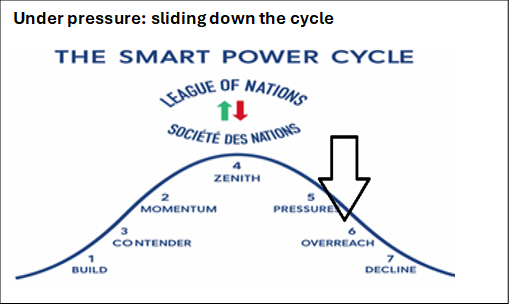
The uncomfortable truth is that both Britain and America now sit in the pressures phase, edging towards overreach. They are still rich, still armed and still noisy. But they are failing where durable power depends: administrative discipline, strategic seriousness and public trust.
It's happened to every Empire in the world.
See the arrows in the graph. That’s where we are now. Hegemons in the pressures stage, facing corruption and state failure, make stupid choices and decline.
Look at the cycles of all those great powers since 1500. Every century, a superpower is challenged by a rising power. Usually with war thrown in to rush the hegemon’s fall along. The old order falls, and the new rises. Mark Twain said it best: history doesn't repeat itself, but it rhymes.
These five superpowers have ruled their eras: Spain, France, Holland, Britain, and the United States. But no power lasts forever. Every 100 years roughly, after a world war, a new power has taken the top spot. Challengers see their moment, trap the hegemon, and seek to overthrow the old order. Spain fell to France. France fell to Britain. Britain fell to the USA. Now, we stand at the dawn of the Chinese century.
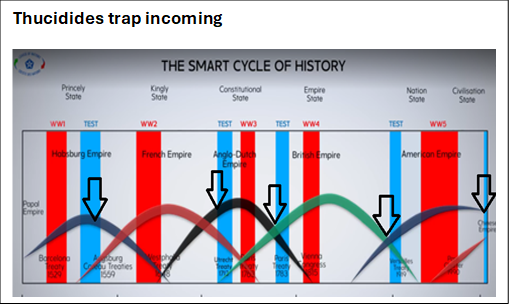
Notice anything about the pattern? The cycle matters because reputations lag realities. Empires seldom look finished at the moment the rot begins. Spain did not think itself finished when Dutch finance rose. France did not think itself finished when Britain learnt to mobilise credit better. Britain itself remained globally glamorous long after its relative advantage was eroding.
Complacency is stupid power, inviting decline. And that's where ignored corruption eating the state ends up.
But it's happened all before.
It’s just like….the 1680’s
The same thing, in the same way.
Smart power shows how the smart and the stupid leaders who’ve been in exactly this spot before got on, what happened, who won and lost and why.
Lessons learned: Two Kings, One War, Opposite Outcomes
The French sun-king, hegemon Louis XIV and William III, his Dutch challenger, both faced the Pressures stage. Their choices, and outcomes, could not have been more different.
The Sun King meets his match
Louis XIV inherited France at its zenith but allowed elite tax evasion to resume after his finance minister Colbert died in 1683. He had 18 years to apply anti-corruption reforms to thwart his enemy and strengthen his absolutist state. He chose not to. When war arrived, France's state could not sustain it. The nobles paid no tax. Neither did the church. Only the peasants paid—and France went bankrupt trying to fund the war. It could only borrow at 8% — because investors did not trust a king who might default on a whim.
Smart Rules score: 1.5/7.
William III arrived in England in 1688 during a corruption crisis under James II with a plan written in advance. He named France as the existential rival. He applied all seven rules systematically: created the Bank of England (1694), passed the Bill of Rights, institutionalised parliamentary control of finance, built the Grand Alliance. When the same test war arrived, England's state could execute. England could borrow cheaply because investors trusted that Parliament—not a king who might default—controlled the purse. Over 13 years of war, that five-percentage-point interest-rate gap proved fatal to France. Score: 7 out of 7. Result: British hegemony for 300 years.
Same war. Different preparation. Opposite outcomes.
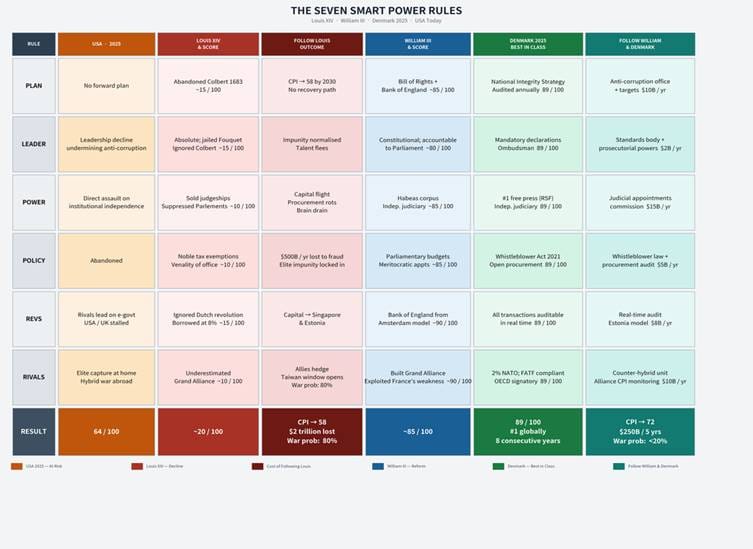
The true heir of William III is the #1 country in the Corruption Perceptions Index and #3 in the State Power League: step forward, Denmark. It has no empire. It has no seat on the Security Council. It has the system. That is all William III ever had. He beat corruption and saved his state.
The United Kingdom and the United States are not Denmark. They are, in the current trajectory, Louis XIV — nations aware of the warning on the scoreboard, and choosing not to read it.
The Smart Choice
In football, a serious club does not answer a bad season by releasing a glossy video and signing another celebrity forward. It fixes recruitment, conditioning, tactics, accountability and the training ground culture. States are no different. Anti-corruption success is not a sermon; it is a management system backed by prosecutors, courts, data, transparent procurement and ministers who fear the rules as much as ordinary citizens do.
The Smart Power Cycle shows you where you are: Stage 5, sliding toward 6, the same position Louis stood in 1683 and William stood in 1688. The smart power rules show you what they did about it. The form table, the CPI data, and the State League scores show you that the UK and US are currently choosing Louis. The rivals are reading the form table. The window is being calculated. The clock is running.
The complacent giant is shocked by the table, discovers the injury is deeper than a run of poor results, studies the winners who handled the same crisis better, and is offered one last chance to change system before relegation becomes destiny. The tragedy is not that the warning is hidden. It is that it is visible on the scoreboard.
The hero of the piece, if one is needed, is not a man. It is a choice. Smart Power provides the map. What you do with it is the only question that remains.