
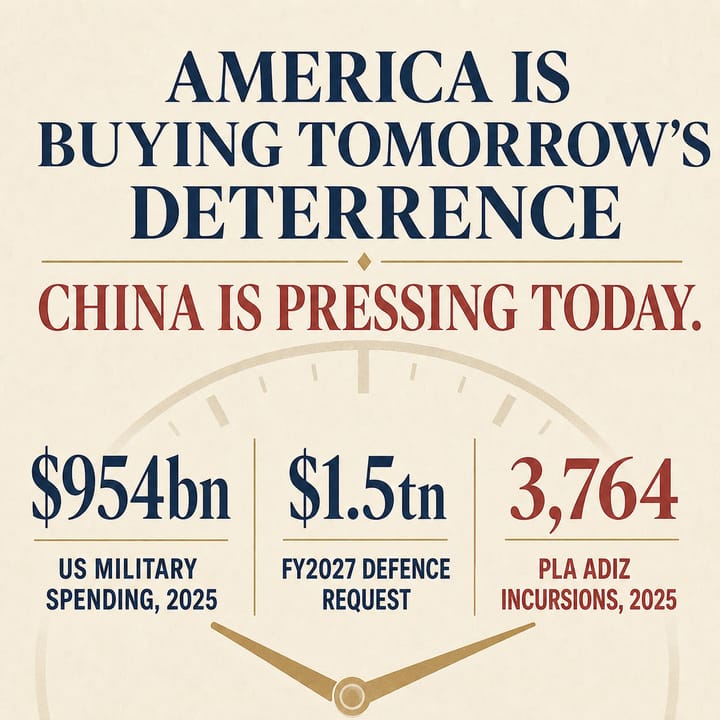
Washington is preparing to spend on a historic scale. Beijing is testing what American power can do before the new money becomes usable military strength.
The United States spent more on its armed forces than any other country in 2025. Yet SIPRI puts the total at $954bn, down 7.5 per cent in real terms from 2024. The White House is now seeking $1.5tn in total defence resources for FY2027.
Those figures are not directly comparable. The first is an estimate of actual military expenditure in one calendar year. The second is a request for future budgetary resources, split between discretionary and mandatory funding, which Congress may alter. Their juxtaposition nevertheless reveals the problem. America is trying to buy a much larger force posture for tomorrow while its commitments are multiplying today.
The chronology matters
The 2025 spending fall did not occur during the present war with Iran. US operations began on 28 February 2026. The completed SIPRI figure is therefore a pre-war baseline, not a wartime spending verdict. SIPRI attributes much of the fall to the absence of new American financial military aid for Ukraine in 2025, after $127bn had been appropriated over the previous three years.
That correction makes the argument more precise. Washington entered 2026 with a smaller real-terms spending base, then took on a costly Gulf conflict while trying to restore deterrence in the Indo-Pacific. The FY2027 request is an attempt to catch up. A request, however, is not a deployed missile, a repaired ship or a replenished magazine.
The Military League of Nations chart below offers the longer view of relative military position. It is a scoreboard, not a forecast.
Beijing works in the present tense
China does not need to match America’s global military budget to exploit this interval. It needs to apply pressure near home, repeatedly and below the threshold that would force Washington into a clear response.
According to CSIS ChinaPower’s compilation of Taiwan’s defence-ministry data, PLA aircraft made 3,764 incursions into Taiwan’s de facto air-defence identification zone in 2025, 22.4 per cent more than in 2024 and the highest annual total recorded in the series.
An ADIZ is not sovereign airspace. An incursion is not an attack. Those distinctions are not pedantry; they are what make the method useful. Beijing can rehearse, collect intelligence, test responses and wear down Taiwan’s forces without presenting the United States with a single obvious moment at which it must act.
The danger is habituation. An exceptional sortie becomes a busy week; a busy week becomes the new baseline. China gains position not by seizing territory, but by making coercion ordinary.
Two fronts, one set of choices
America has ample power, but every choice now carries a cost.
The Gulf and the Pacific draw on overlapping stocks, surveillance assets, air and missile defences, transport capacity and senior attention. A larger budget can expand those resources over time. It cannot make every munition or ship appear at once. Nor does a startling headline number guarantee sensible allocation: a request far above the likely appropriation can hand decisive choices back to Congress. The services must then turn the result into contracts, and industry must deliver.
There is a domestic cost as well. A June estimate reported by CBS News put the Iran war’s additional burden at roughly $1,000 for a typical American household, including fuel, food, borrowing, air travel and an estimate of taxpayer costs. That is an economist’s estimate rather than an official total, and other studies produce lower figures. It should be read as a warning about pass-through costs, not as a settled bill.
The strategic risk is similar. Washington may pay more and still receive less security if resources are not directed towards the theatre and capabilities that matter most.
The old pattern
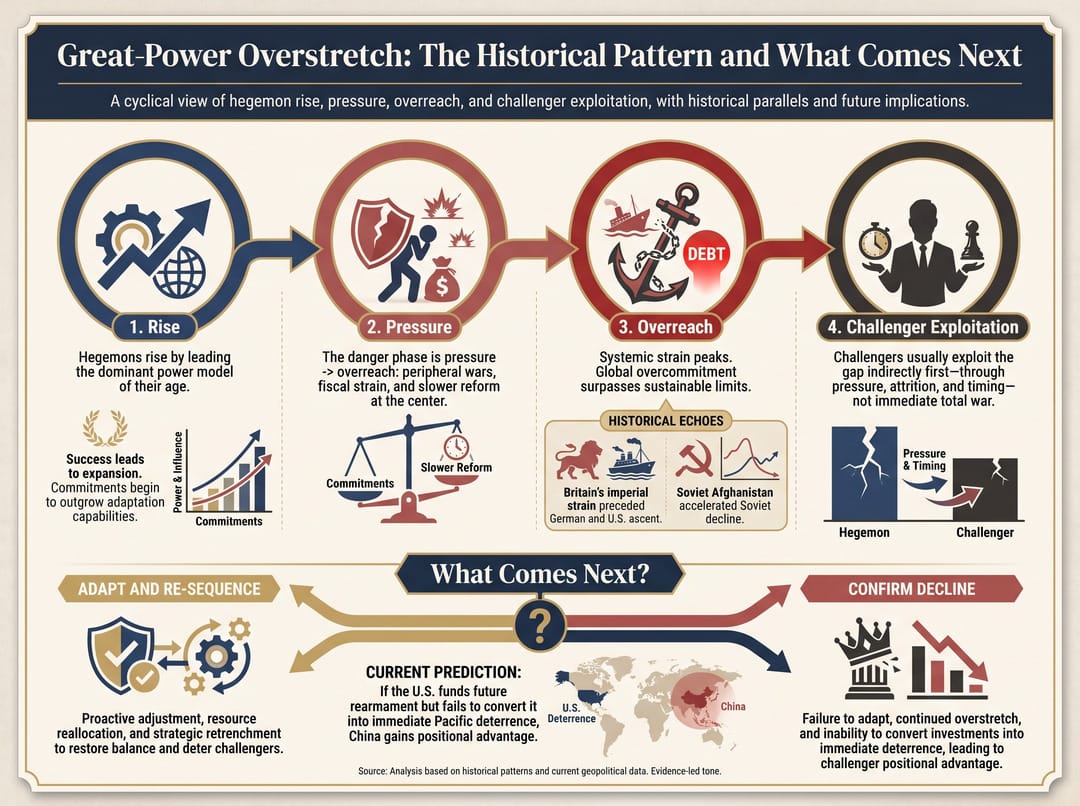
The League’s working model of great-power overreach. It is an analytical framework, not a deterministic forecast.
History does not supply a timetable for American decline. It does offer a recurring problem. Great powers become vulnerable when commitments multiply faster than their institutions can adapt.
Late-imperial Britain still commanded enormous resources while fighting peripheral wars and watching Germany and the United States rise in the decisive industrial fields. The Soviet Union did not collapse because Afghanistan alone defeated it. The war mattered because it consumed resources and exposed weaknesses already present in the system.
America is not Britain in 1900 or the Soviet Union in 1985. Analogies become dangerous when they substitute resemblance for analysis. The useful comparison is narrower: latent strength can remain impressive while strategic freedom contracts.
What Smart Power would do
The usual argument over spending misses the practical issue: what is the money for?
First, Washington should state its theatre priorities plainly. If preventing coercive change around Taiwan is the central test, the munitions, shipbuilding, surveillance and logistics required for that mission should be protected from unplanned depletion elsewhere.
Second, emergency Gulf costs should be transparent and separate from the long-term force programme. Supplementals that conceal trade-offs encourage the fiction that every commitment can be added without consequence.
Third, deterrence must be judged by delivery. The useful measures are stockpile depth, repair time, dispersal, secure communications, allied access and the speed at which Taiwan receives survivable capabilities—not the size of a press-release topline.
Britain has an interest in this discipline. British security still rests heavily on American capacity, while the Global Combat Air Programme with Japan and Italy ties part of Britain’s industrial future to Indo-Pacific stability. A United States stretched between theatres leaves its allies with choices of their own.
Final whistle
America remains ahead in resources and behind in timing. Its FY2027 request is evidence that Washington recognises the strain; it is not proof that the strain has been resolved.
On the present evidence, the United States is not yet bucking the cycle of overextension. It can still delay or reverse it, but only by converting future appropriations into present, theatre-ready deterrence and by accepting that priorities require saying no as well as spending more.
China need not become stronger everywhere. It can press in one decisive place while America is busy in several. The next phase will turn less on the size of Washington’s cheque than on what arrives before Beijing changes the baseline again.